
Category: PPP
DHCPv6-RADIUS integration: the Cisco way
Yesterday I described how the IPv6 architects split the functionality of IPCP into three different protocols (IPCPv6, RA and DHCPv6). While the split undoubtedly makes sense from the academic perspective, the service providers offering PPP-based services (including DSL and retrograde uses of PPP-over-FTTH) went berserk. They were already using RADIUS to authenticate PPP users ... and were not thrilled by the idea that they should deploy DHCPv6 servers just to make the protocol stack look nicer.
IPv6CP+DHCPv6+SLAAC+RA = IPCP
Last week I got an interesting tweet: “Hey @ioshints can you tell me what is the radius parameter to send ipv6 dns servers at pppoe negotiation?” It turned out that the writer wanted to propagate IPv6 DNS server address with IPv6CP, which doesn’t work. Contrary to IPCP, IPv6CP provides just the bare acknowledgement that the two nodes are willing to use IPv6. All other parameters have to be negotiated with DHCPv6 or ICMPv6 (RA/SLAAC).
The following table compares the capabilities of IPCP with those offered by a combination of DHCPv6, SLAAC and RA (IPv6CP is totally useless as a host parameter negotiation tool):
DHCPv6 over PPPoE: Total disaster
Every time someone throws me an IPv6 curveball, I’m surprised when I discover another huge can of worms (I guess I should have learned by now). This time it started pretty innocently with a seemingly simple PPPoE question:
What happens if an ISP decides to assign dynamic IPv6 subnets? With static assignment, the whole stuff is pretty straight-forward due to ND, RA & DHCPv6, but if dynamic addresses are used, what happens if the subnet changes - how will the change be propagated to the end-user devices? The whole thing is no problem today due to the usage of NAT / PAT...
LAN address allocation with changing DHCPv6 prefix is definitely a major problem, but didn’t seem insurmountable. After all, you can tweak RA timers on the LAN interface, so even though the prefix delegated through DHCPv6 would change, the LAN clients would pick up the change pretty quickly. WRONG ... at least if you use Cisco IOS.
L2TP: The revenge of hardware switching
Do you like the solutions to the L2TP default routing problem? If you do, the ASR 1000 definitely doesn’t share your opinion; so far it’s impossible to configure a working combination of L2TP, IPSec (described in the original post) and PBR or VRFs:
PBR on virtual templates: doesn’t work.
Virtual template interface in a VRF: IPSec termination in a VRF doesn’t work.
L2TP interface in a VRF: This one was closest to working. In some software releases IPSec started, but the L2TP code was not (fully?) VRF-aware, so the LNS-to-LAC packets used global routing table. In other software releases IPSec would not start.
L2TP default routing: solutions
There are three tools that can (according to a CCIE friend of mine) solve any networking-related problems: GRE tunnels, PBR and VRFs. The solutions to the L2TP default routing challenge nicely prove this hypothesis; most of them use at least one of those tools.
Policy-based routing on virtual template interface. Use the default route toward the Internet and configure PBR with set default next-hop on the virtual template interface. The PBR is inherited by all virtual access interfaces, ensuring that the traffic from remote sites always passes the network core (and the firewall, if needed).
Small Steps to Large Complexity
Imagine you have a large retail network: your remote offices use ISDN to dial into the central site and upload/download whatever periodic reports they have. Having a core router connected to an ISDN PRI interface is the perfect solution:
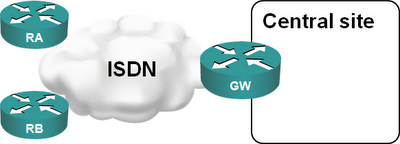
A few years later, ISDN is becoming too slow for your increased traffic needs and you want to replace it with DSL or VPN-over-Internet solution. Your Service Provider offers you PPPoE forwarding with L2TP. This is a perfect solution as it allows you to minimize the changes:
OSPF Breaks When Faced With Overlapping IP Addresses
A while ago cciepursuit described his problems with PPP-over-Frame Relay. Most probably his problems were caused by a static IP address assigned to the virtual template interface (this address gets cloned to all virtual access interfaces and IOS allows you to have the same IP address on multiple WAN point-to-point links). I recreated a very similar (obviously seriously broken) scenario in my lab using point-to-point subinterfaces over Frame Relay to simplify the setup.
Internet Access Russian Dolls
When the local Telco installed my blindingly fast 20 Mbps Internet-over-fiber-cable service, I was expecting to use DHCP on the router’s outside interface to connect to the Internet. After all, they’re running switched Ethernet VLANs over the fiber cable, and using DHCP seemed a logical choice. Imagine my surprise when I had to configure PPP-over-Ethernet (PPPoE) – it was as if I would be using a DSL connection, not a fiber-optic cable.
Multilink bundles have varying bandwidth
I have always intuitively assumed that the interface bandwidth on MLPPP bundles is the sum of interface bandwidths of individual interfaces that are part of the bundle. Recently I’ve tested my assumption and it works as expected.
PPP default route
One of those readers that prefer to remain anonymous has left an interesting comment to my post “Almost-dynamic routing over ADSL interfaces”:
You do not need the route "ip route 0.0.0.0 0.0.0.0 Dialer0 10 track 100" and the tracking if you configure "ppp ipcp route default" on the dialer interface. Works the same way... :-)
You might be wondering why Cisco's engineers decided to pollute IOS with yet another feature. The problem they had was the way PPP over Frame Relay is implemented: it uses virtual interfaces and although you have a very static connection, you cannot bind a static interface name to it. A dynamic interface (with potentially changing name) is cloned from the virtual template every time the PPP-over-Frame-relay session is started. Obviously you cannot configure a static default route pointing to it in advance, so you need yet another feature to do it (I'll not even try to figure out how to create non-default static routes pointing to cloned interface).