
… updated on Friday, April 24, 2026 08:30 +0200
Ten Years of ITNOG
I spent the last two days in Bologna at ITNOG 10 in the excellent company of Italian networking engineers (many of them personal friends) and a few guests from around the world. As always, the organizers and the program committee didn’t disappoint – it was a smoothly organized, lovely event full of interesting presentations. Thanks a million to everyone involved; I’ll definitely be back!
Now for the highlights, starting with the ultimate catnip for the differently attentive: running two presentations in parallel on the same screen with the soundtrack distributed via headphones. I’ve never seen anything like that, and while it looked weird (I have no idea how the presenters took it), it turned out to be very useful, as you could easily tune out AI-washing presentations and switch to something more interesting. On the other hand, you could be faced with a hard choice of having to select one of two excellent presentations:
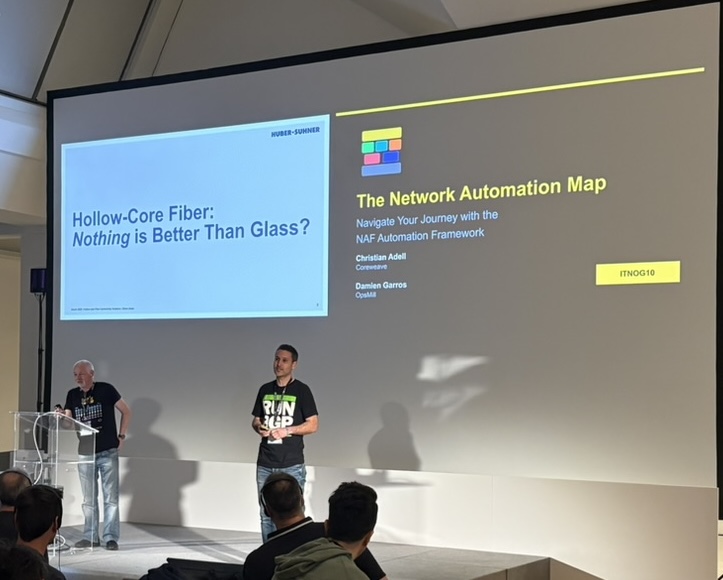
Steve Jones and Christian Adell competing for audience’s attention
I was thus forced to miss some of the presentations; these are the ones I enjoyed most1:
National Layer-2 wholesale FWA leveraging VxLAN – Christian Biasibetti persuaded ASIC vendors to include VXLAN silicon in 5G-to-Ethernet chips and device vendors to use that feature, allowing his company to build a layer-2-over-5G service using VXLAN.
Security Functions in EVPN/VXLAN Using Group-Based Policy – Did you know that there’s an RFC that allows you to use 16 bits in the VXLAN header as a security group and add a BGP community to EVPN routes to automatically map EVPN destinations to those security groups? Nicola Modena explained how the technology works and how you can use this barely-known function to implement microsegmentation and service insertion.
Transforming BGP operations to serve the best prefix out of 26 million – Alessandro D’Eliseo explained how his company optimized end-to-end routing using BGP AddPath and BGP Optimal Route Reflection functionality (as suggested by Nicola Modena’s presentation from 2022), combined with BGP RIB sharding, update threading, and prefix prioritization for faster information dissemination. Their route reflectors (running as VMs on decent hardware2) currently handle 26 million paths.
Hollow Core Fibre by Steve Jones was an intriguing introduction into the world of carrying light in the void between the fibers, resulting in 30% reduced latency, reduced signal loss, and significantly higher power budgets. The gotchas: limited availability and high cost, but one can hope that the economies of scale will kick in.
AS/IXP Traffic Observability by Luca Deri (author of ntopng and a guest on the Software Gone Wild podcast) was an nice overview of new ntopng features, including BGP integration and the web interface. The screenshots looked almost like I’d be watching a Kentik presentation3.
I’m positive the Network Automation Framework presentation by Christian Adell and Damien Garros4 was also great, but unfortunately, I had to choose between that or void in the fiber, and the futuristic title won.
Now for a pair of minor drawbacks:
- Most of the presentations were in Italian. Fortunately, my 1K-day streak on Duolingo paid its dividends, and I was able to follow most of them (at least when the slides were in English). Definitely something to consider if you’re intrigued by ITNOG content but not fluent in Italian. But hey, Bologna is known for great food, so…
- The vendors can’t resist AI-washing. The SRv6 uSID for Deterministic AI Backend Networking title says it all.
The latter annoyance was easy to fix. Most of the vendor marketing pitches were in the two-track part of the event, so it wasn’t hard to ignore them ;), and you could always opt out and spend some time with an excellent espresso ;))
Revision History
- 2026-04-24
- Added links to slide decks
-
I will add links to the slides if the materials get published. I don’t think they were recorded. ↩︎
-
Because no vendor would pay as much for a CPU they put in their 100K$ box. ↩︎
-
Avi Freedman from Kentik was also a guest on Software Gone Wild. ↩︎
-
Another Software Gone Wild guest ;) and a speaker in ipSpace.net network automation course. ↩︎
I can only add that, while I personally lean toward talks in Italian (for obvious cognitive bandwidth reasons 😄), the real deciding factor is always the presenter’s skill. ;-)
As for the parallel tracks experiment—having two channels in the headphones was already clever—but I would have gone one step further and added a third option: a “chaos mix” channel blending both speakers together. Perfect for mentally channel-hopping without actually committing to either talk! LOL
Ivan, it's always a pleasure to meet and talk to you. Your session on using NetLab and the project is a great value to the community and to anyone who truly wants to learn. My presentation on Group Based Policy is available here: https://github.com/nmodena/blog/blob/master/202604-nmodena-EVPN-VXLAN-Group-Based-Policy-ITNOG10.pdf
For “Transforming BGP operations to serve the best prefix out of 26 million,” which solution did they use?
I hope I managed to remember all the technologies they mentioned to get it done.
I'm guessing Junos is still the only one that implemented all of them. Am I missing something? Does this https://blog.ipspace.net/2021/11/multi-threaded-routing-daemons/ need to be updated?
I suppose this is Juniper vRR. There is also Juniper cRPD which would be another option if Juniper was providing a bit more guidance on how to optimize your setup.
Here, we are switching to Nokia SROS (packaged as an appliance), mainly because RIB sharding is not implemented with SRv6 on Junos and it makes an RR slow as molasses.