
ATAoE: response from Coraid
A few days after writing my ATAoE post I got a very nice e-mail from Sam Hopkins from Coraid responding to every single point I’ve raised in my post. I have to admit I’ve missed the tag field in the ATAoE packets which does allow parallel requests between a server and a storage array, solving some of the sequencing/fragmentation issues. I’m still not convinced, but here is the whole e-mail (I did just some slight formatting) with no further comments from my side.
DMVPN: Non-Unique NHRP Registrations
During my last DMVPN webinar, one of the students mentioned the need for non-unique NHRP registrations in environments where the public IP address of a DMVPN spoke site changes due to DHCP lease expiration or PPPoE session termination. Finally I found some time to recreate the scenario in my DMVPN lab; here are the results.
Hiding documentation ... will they never learn?
One of the best presentations we had last week during the Net Field Day 2010 was given by Doug Gourlay from Arista. Their products have numerous highly interesting features; Terry liked their use of TDR and I was particularly delighted by the VM Tracer and decided to write about it as soon as I find some time (read: today).
2012-09-29: To keep the record straight: a few months after I wrote this blog post, Arista made most of the EOS documentation available online (as of today, it's latest version only, with no release notes).
Setting access lists with RADIUS
Chris sent me an interesting challenge a few days ago: he wanted to set inbound access lists on virtual access interfaces with RADIUS but somehow couldn’t get this feature to work.
Uncle Google quickly provided two documents on Cisco.com: an older one (explaining the IETF attributes, vendor-specific attributes and AV-pairs) and the most recent one (with more attributes and less useful information) covering every Cisco IOS software release up to 12.2 (yeah, it looks like the RADIUS attributes haven’t been touched in a long time). According to the documentation, attribute #11 as well as AV-pairs ip:inacl/ip:outacl and lcp:interface-config should work, but the access list did not appear in the interface configuration.
Advanced DMVPN Webinar: Router Configurations
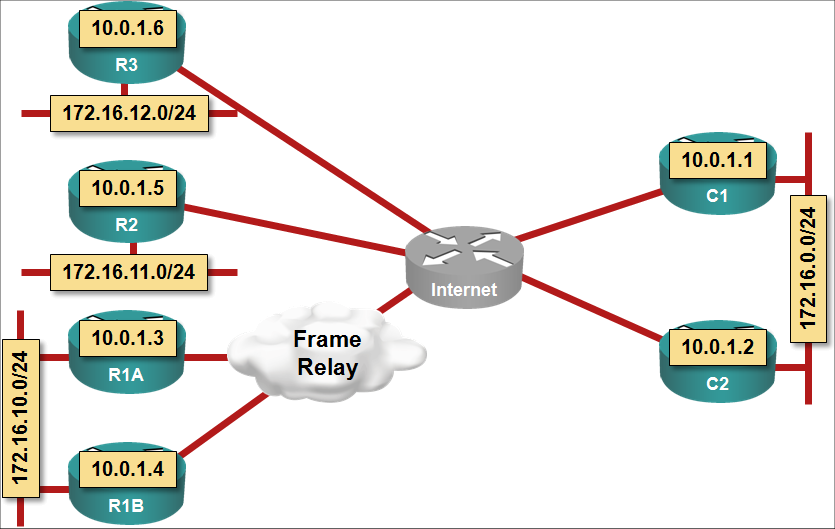
I included 12 sets of complete router configurations with the DMVPN webinar covering every single design scenario described in the webinar. The seven router lab topology emulates an enterprise DMVPN deployment with a redundant central site, a redundant remote site (with two routers) and two non-redundant remote sites (using two uplinks in a few scenarios). The seventh router emulates the Internet. The configurations can be used on any hardware (real or otherwise) supporting recent Cisco IOS software, allowing you to test and modify the design scenarios discussed in the webinar.
Multihop FCoE 102: VN_port proxy and FIP snooping
A few weeks ago I wrote about the multihop FCoE basics and the two fundamentally different ways an FCoE network could be designed: FCoE on every switch or FCoE on the edges with DCB-extended bridging in the middle.
There are two other configurations you’ll likely see in access parts of an FCoE network: FCoE VN_port proxying and FIP snooping.
Virtualization links (2010-09-19)
A medley of virtualization/access network links:
Access layer virtualization: VN-Tag and VEPA. A nice summary of what Cisco and HP are trying to sell us as VN-Tag and VEPA. The truth might be a bit different (definitely not Joe’s fault).
UCS Network Adapter Options Overview. A nice summary of three NIC architectures with a reasonable answer to the question: “why would I need virtual NICs in my server?” applicable to a generic Data Center environment.
Net Field Day 2010 – first impressions
I just spent frantic three days in San Jose with a dozen of fellow bloggers attending the Net Field Day 2010 event masterfully organized by Stephen Foskett and Claire Chaplais (thank you both for a truly outstanding experience!). I can’t tell you how delighted I was when they selected me as one of the participants, more so as this event finally allowed me to get in touch with a number of people I was regularly meeting in vSpace. However, the whole point of the Net Field Day is to talk with the vendors and figure out what they’re doing, so let’s start with my first impressions.
The sorry state of the industry. My first impression: real networking innovation is gone.
ATAoE for Converged Data Center Networks? No Way
When I started writing about storage industry and its attempts to tweak Ethernet to its needs, someone mentioned ATAoE. I read the ATAoE Wikipedia article and concluded that this dinky technology probably makes sense in a small home office… and then I’ve stumbled across an article in The Register that claimed you could run a 9000-user Exchange server on ATAoE storage. It was time to deep-dive into this “interesting” L2+7 protocol. As expected, there are numerous good reasons you won’t hear about ATAoE in my Data Center 3.0 for Networking Engineers webinar.
Storage networking is like SNA
I’m writing this post while travelling to the Net Field Day 2010, the successor to the awesome Tech Field Day 2010 during which the FCoTR technology was launched. It’s thus only fair to extend that fantastic merger of two technologies we all love, look at the bigger picture and compare storage networking with SNA.
Notes:
- If you’re too young to understand what I’m talking about, don’t worry. Yes, you’ve missed all the beauties of RSRB/DLSw, CIP, APPN/APPI and the likes, but major technology shifts happen every other decade or so, so you’ll be able to use FC/FCoE/iSCSI analogies the next time (and look like a dinosaur to the rookies). Make sure, though, that you read the summary.
- I’ll use present tense throughout the post when comparing both environments although SNA should be mostly history by now.