
VMware Virtual Switch: no need for STP
During the Data Center 3.0 webinar I always mention that you can connect a VMware ESX server (with embedded virtual switch) to the network through multiple active uplinks without link aggregation. The response is very predictable: I get a few “how does that work” questions in the next seconds.
VMware did a great job with the virtual switch embedded in the VMware hypervisor (vNetwork Standard Switch – vSS – or vNetwork Distributed Switch – vDS): it uses special forwarding rules (I call them split horizon switching, Cisco UCS documentation uses the term End Host Mode) that prevent forwarding loops without resorting to STP or port blocking.
Cisco IOS Login Enhancements are not IPv6-aware
One of the comments to my “IPv6 in Data Center: after a year, Cisco is still not ready” post included the following facts:
Up through at least 15.0(1)M and 12.2(53)SE2 the IPv6 support for management protocols is spotty; syslog is there, SNMP traps and the RADIUS/TACACS control plane aren't.
Another bug along the same lines was discovered by Jónatan Jónasson: When the Cisco IOS Login Enhancements feature logs successful or failed login attempt, it reports the top 32 bits of the remote IPv6 address in IPv4 address format. Here’s a sample printout taken from a router running IOS release 15.0(1)M.
Content over IPv6: No Excuses!
Yesterday I spent the whole day at another fantastic IPv6 Summit organized by Jan Žorž of the go6 institute. He managed to get two networking legends: Patrik Fältström (he was, among numerous other things, a member of Internet Architecture Board) had the keynote speech (starts @ 11:40) and Daniel Karrenberg (of the RIPE fame) was chairing the technical panel discussion. My small contribution was a half-hour talk on the importance of IPv6-enabled content (starts @ 37:00).
IPv6 in Data Center: after a year, Cisco is still not ready
Today I’m delivering another IPv6 presentation, this time at the 4th Slovenian IPv6 Summit organized by tireless Jan Žorž from the go6 Slovenian IPv6 initiative. It’s thus just the right time to review the post I wrote a bit more than a year ago about lack of IPv6 readiness in Cisco’s Data Center products. Let’s see what has changed in a year:
Time-Based Static Routes
Before someone accuses me of being totally FCoE/DCB-focused, here’s an interesting EEM trick. Damian wanted to have time-dependent static routes to ensure expensive backup path is only established during the working hours. I told him to use cron with EEM to modify router configuration (and obviously lost him in the acronym forest)... but there’s an even better solution: use reliable static routing and modify just the track object’s state with EEM.
Confusopoly
Undoubtedly Scott Adams is following the Cisco/Brocade FCoE/QCN/TRILL "discussions".

FCoE, QCN and Frame Relay analogies
Just when I hoped we were finally getting somewhere with the FCoE/QCN discussion, Brocade managed to muddy the waters with its we-still-don’t-know-what-it-is announcement. Not surprisingly, networking consultants like my friend Greg Ferro of the Etherealmind fame responded to the shenanigan with statements like “FCoE ... is a technology so mindboggingly complicated that marketing people can argue over competing claims and all be correct.” Not true, the whole thing is exceedingly simple once you understand the architecture (and the marketing people always had competing claims).
Pretend for a minute that FC ≈ IP and LAN bridging ≈ Frame Relay, teleport into this parallel universe and allow me to tell you the whole story once again in more familiar terms.
Nexus 1000V: another IPv6 #FAIL
Just stumbled across this unbelievable fact in the Nexus 1000V release notes:
IPV6 ACL rules are not supported.
My first reaction: “You must be kidding, right? Are we still in 20th century?” ... and then it dawned on me: Nexus 1000V is using the NX-OS control plane and it’s still stuck in 4.0 release which did not support IPv6 ACLs (IPv6 support was added to NX-OS in release 4.1(2)).
Does FCoE need QCN (802.1Qau)?
One of the recurring religious FCoE-related debates of the last months is undoubtedly “do you need QCN to run FCoE” with Cisco adamantly claiming you don’t (hint: Nexus doesn’t support it) and HP claiming you do (hint: their switch software lacks FC stack) ... and then there’s this recent announcement from Brocade (more about it in a future post). As is usually the case, Cisco and HP are both right ... depending on how you design your multi-hop FCoE network.
Data Center Bridging (DCB) Congestion Notification (802.1Qau)
The last (and the least popular) Data Center Bridging (DCB) standard tries to solve the problem of congestion in large bridged domains (PFC enables lossless transport and ETS standardizes DWRR queuing). To illustrate the need for congestion control, consider a simple example shown in the following diagram:
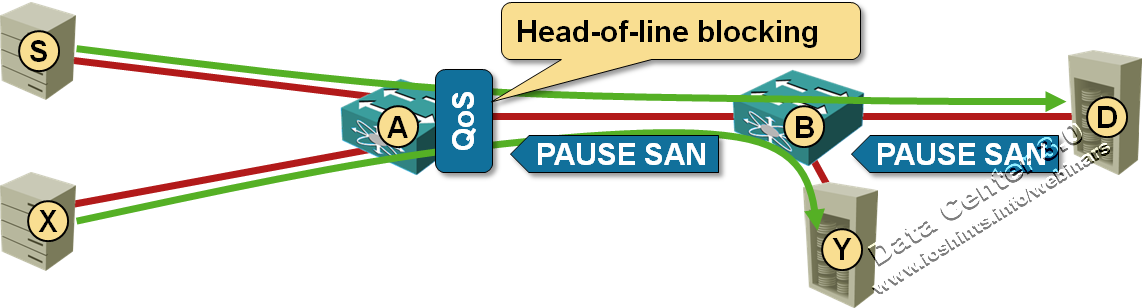
It came to my attention that a vendor might be using this blog post to justify the need for QCN in FCoE environments. Should that be the case, please make sure you also read about the difference between dense and sparse FCoE, the (lack of) need for QCN in FCoE and whether it makes sense to run FCoE over TRILL. Finally, consider how you’ll troubleshoot FCoE environments.