
… updated on Sunday, December 27, 2020 17:54 UTC
vCloud Disruptiveness: Nothing New
The vCloud Director: hand the network over to server admins post received several fantastic well-reasoned comments that you should read in their entirety. Jónatan Natti correctly pointed out (among other things) that we’ve often heard “And now a networking vendor is trying to persuade people with limited exposure to […] issues to rebuild […]" where […] could stand for Voice/PBX, SNA or storage.
Update 2020-12-27: The original blog post was written in 2010 when vCloud Director and the weird MAC-in-MAC encapsulation it used was all the craze in some circles (and in particular in vendor slide decks).
The hype I was making fun of didn’t last long. The encapsulation quickly got replaced by VXLAN, the whole product died a few years later, and now VMware NSX-T and VMware on AWS are the new miracle technologies.
DHCP the Microsoft way: almost standard
Srinivas sent me the following printout a few days ago and asked me whether I could explain the weird DHCP bindings (I removed the lease expiration column from the printout):
Switch#sh ip dhcp binding
Bindings from all pools not associated with VRF:
IP address          Client-ID/              Type
                    Hardware address/
                    User name
192.168.101.140     0152.4153.2000.188b.    Automatic
                    cfb7.f800.0000.0000.
                    00
192.168.101.141     0152.4153.2000.188b.    Automatic
                    cfb7.f800.0001.0000.
                    00
vCloud Director: hand the network over to server admins
A few months ago VMware decided to kick away one of the more stubborn obstacles in their way to Data Center domination: the networking team. Their vCloud architecture implements VLANs, NAT, firewalls and a bit of IP routing within the VMware hypervisor and add-on modules ... and just to make sure the networking team has no chance of interfering, they implemented MAC-in-MAC encapsulation, making their cloudy dreamworld totally invisible to the lowly net admins.
VPLS is a technology, not just a service provider offering
The Internet Exchange and Peering Points Packet Pushers Podcast is as good as the rest of them (listen to it first and then continue reading), but also strangely relevant to the data center engineers. When you look beyond the peering policies, route servers and BGP tidbits, an internet exchange is a high-performance large-scale layer-2 network that some data center switching vendors are dreaming about ... the only difference being that the internet exchanges have to perform extremely well using existing products and technologies, not the shortest-path-bridging futures promised by the vendors.
IPv6 Addressing: How Wrong Can You Get It?
Mike was wondering whether his ISP is giving him what he needs to start an IPv6 pilot within his enterprise network. He wrote:
So I got an IPv6 assignment with a /120 mask (basically our IPv4/24 network mapped to IPv6) and two smaller networks to use for links between our external router and the ISP.
Dear Mike’s ISP: where were you when the rest of the world was preparing to deploy IPv6? Did you read IPv6 Unicast Address Assignment Considerations (RFC 5375) or IPv6 Address Allocation and Assignment Policy from RIPE or your regional registry?
Solving the MPLS/VPN QoS Challenge
Two weeks ago I wrote about the challenges you’ll encounter when trying to implement end-to-end QoS in an enterprise network that uses MPLS/VPN service as one of its transport components. Most of the issues you’ll encounter are caused by the position of the user-SP demarcation point. The Service Providers smartly “assume” the demarcation point is the PE-router interface… and everything up to that point (including their access network) is your problem.
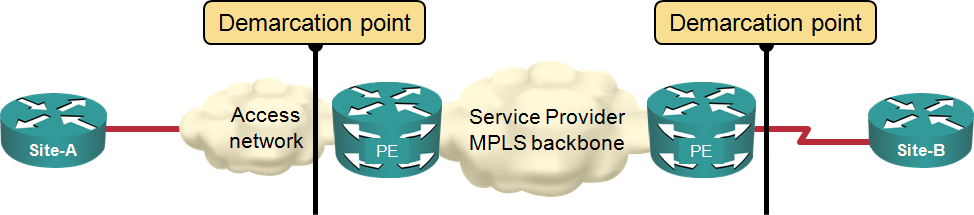
Typical MPLS/VPN demarcation point
What is MPLS-TP and is it relevant?
At the time when I was writing my MPLS books and developing MPLS courses for Cisco, everyone was ecstatically promoting GMPLS (Generalized MPLS) as the next unifying technology of everything, making someone so fed up with the fad that he wrote the Electricity over IP RFC.
GMPLS got implemented in high-end routers, but never really took off (at least I’ve never seen or even heard about it). Obviously the transport teams found the idea of routers requesting on-demand lambdas with IP-based protocols too hard to swallow.
External Brains Driving an MLAG Cluster
Juniper has introduced an interesting twist to the Stacking on Steroids architecture: the brains of the box (control plane) are outsourced. When you want to build a virtual chassis (Juniper’s marketing term for stack of core switches) out of EX8200 switches, you offload all the control-plane functionality (Spanning Tree Protocol, Link Aggregation Control Protocol, first-hop redundancy protocol, routing protocols) to an external box (XRE200).
Interesting links (2010-10-31)
This set of links is somewhat different: they all deal with IT, but mostly with non-technical part of it.
Kevin Bovis @ Etherealmind continues a series of great insightful articles with Network Design – Creativity and Compromise. Must-read for anyone striving to be involved in network design.
The IT Disconnect by Tom Carpenter tackles one of the fundamental IT issues: we’re too busy dealing with our problems to focus on the problems of those paying us to deliver the service.
DHCPv6 relaying: another trouble spot?
My DHCPv6+PPPoE post received a very comprehensive comment from Ole Troan (thank you!) in which he explains the context in which DHCPv6 was developed (a mechanism to give a static IPv6 prefix to a customer) and its intended usage (as the prefix is static, it should have a very long lifetime).
However, when you deploy DHCPv6 in some modern access networks (it’s not just PPPoE, Carrier Ethernet fares no better), you might experience subtle problems. Let’s start with a step-by-step description of how DHCPv6 works: