
On SDN Controllers, Interconnectedness and Failure Domains
A long long time ago Colin Dixon wrote the following tweet in response to my Controller Cluster Is a Single Failure Domain blog post:
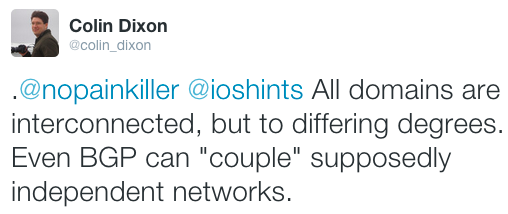
He’s obviously right, but I wasn’t talking about interconnected domains, but failure domains (yeah, I know, you could argue they are the same, but do read on).
OMG, VXLAN Encapsulation Has No Security!
Every now and then someone actually looks at the VXLAN packet format and eventually figures out that VXLAN encapsulation doesn’t provide any intrinsic security.
TL&DR Summary: That’s old news, the sky is not falling, and deploying VXLAN won’t make your network less secure than traditional VLAN- or MPLS-based networks.
Hardware Gateways in Overlay Virtual Networks
Whenever I’m running an SDDC workshop or doing on-site SDN/SDDC-related consulting, the question of hardware gateways between overlay virtual networks and physical world inevitably pops up.
My usual answer: You have to understand (A) what type of gateway you need, (B) what performance you need and (C) what form factor will give you that performance. For more details, watch the Hardware Gateways video from Scaling Overlay Virtual Networks webinar
Rearchitecting L3-Only Networks
One of the responses I got on my “What is Layer-2” post was
Ivan, are you saying to use L3 switches everywhere with /31 on the switch ports and the servers/workstation?
While that solution would work (and I know a few people who are using it with reasonable success), it’s nothing more than creative use of existing routing paradigms; we need something better.
NSONE – Data-Driven DNS on Software Gone Wild
DNS is a crucial component in modern scale-out application architectures, so when Alex Vayl and Kris Beevers from NSONE contacted me just as I was starting to work on my Active-Active Data Centers presentation, I was more than interested to hear what their solution can do.
The result: Episode 29 of Software Gone Wild in which we discussed a number of topics including:
How Do I Get Started with SDN and Virtualization?
Here’s a short question I got from one of my readers:
I am a CCIE in SP/DC & working as Technical Architect in US. I follow your website but I don’t know where to start for SDN/Virtualization/Openstack…
I guess he’s not alone, so here’s a long list of resources I put together in the last 5+ years.
Before I get started: you’ll find links to most of these resources on ipSpace.net SDN Resources page.
Design Challenge: Multiple Data Centers Connected with Slow Links
One of my readers sent me this question:
What is best practice to get a copy of the VM image from DC1 to DC2 for DR when you have subrate (155 Mbps in my case) Metro Ethernet services between DC1 and DC2?
The slow link between the data centers effectively rules out any ideas of live VM migration; to figure out what you should be doing, you have to focus on business needs.
Video: IPv6 Microsegmentation
The video of my Troopers 15 IPv6 Microsegmentation presentation has been published on YouTube. As with the Automating Network Security video, it’s hard to read the slides; you might want to look at the slide deck on my public content web site.
You’ll find more about this topic, including tested Cisco IOS configurations, in IPv6 Microsegmentation webinar.
There’s a Difference between Scaling and Not Being Stupid
I was listening to one of the HP SDN Packet Pushers podcasts in which Greg made an interesting comment along the lines of “people say that OpenFlow doesn’t scale, but what HP does with its IMC is it verifies the amount of TCAM in the switches, checks whether it can install new flows, and throws an alert if it runs out of TCAM.”
Are your ESXi uplinks saturated?
Iwan Rahabok sent me a link to a nice vRealize setup he put together to measure maximum utilization across all uplinks of a VMware host. Pretty handy when the virtualization people start deploying servers with two 10GE uplinks with all sorts of traffic haphazardly assigned to one or both of them.
Oh, if the previous paragraph sounds like Latin, and you should know a bit about vSphere/ESXi, take a hefty dose of my vSphere 6 webinar ;)