
Category: TCP
Multipath TCP on Software Gone Wild
I mentioned Multipath TCP (MP-TCP) numerous times in the past but I never managed to get beyond “this is the thing that might solve some TCP multihoming challenges” We fixed this omission in Episode 100 of Software Gone Wild with Christoph Paasch (software engineer @ Apple) and Mat Martineau from Open Source Technology Center @ Intel.
Worth Reading: Discovering Issues with HTTP/2
A while ago I found an interesting analysis of HTTP/2 behavior under adverse network conditions. Not surprisingly:
When there is packet loss on the network, congestion controls at the TCP layer will throttle the HTTP/2 streams that are multiplexed within fewer TCP connections. Additionally, because of TCP retry logic, packet loss affecting a single TCP connection will simultaneously impact several HTTP/2 streams while retries occur. In other words, head-of-line blocking has effectively moved from layer 7 of the network stack down to layer 4.
What exactly did anyone expect? We discovered the same problems running TCP/IP over SSH a long while ago, but then too many people insist on ignoring history and learning from their own experience.
Video: Tools and Knobs to Use when Tweaking TCP Performance
In the second half of his Networks, Buffers, and Drops webinar JR Rivers focused on end systems: what tools could you use to measure end-to-end TCP throughput, or monitor performance of an individual socket or the whole TCP stack?
To Jumbo or Not to Jumbo?
Here’s the question I got from one of my readers:
Do you have any data available to show the benefits of jumbo frames in 40GE/100GE networks?
In case you’re wondering why he went down this path, here’s the underlying problem:
TCP in the Data Center and Beyond on Software Gone Wild
In autumn 2016 I embarked on a quest to figure out how TCP really works and whether big buffers in data center switches make sense. One of the obvious stops on this journey was a chat with Thomas Graf, Linux Core Team member and a founding member of the Cilium project.
Policing or Shaping? It Depends
One of my readers watched my TCP, HTTP and SPDY webinar and disagreed with my assertion that shaping sometimes works better than policing.
TL&DR summary: policing = dropping excess packets, shaping = delaying excess packets.
Here’s the picture he sent me (watch the video to get the context and read this article to get the background details):
TCP Congestion Avoidance on Satellite Links
While some people spread misinformation others work hard to figure out how to make TCP work on exotic links with low bandwidth and one second RTT.
Ulrich Speidel published a highly interesting article on APNIC blog describing the challenges of satellite Internet access and the approach (network coded TCP) they took to avoid them.
On the Lossiness of TCP
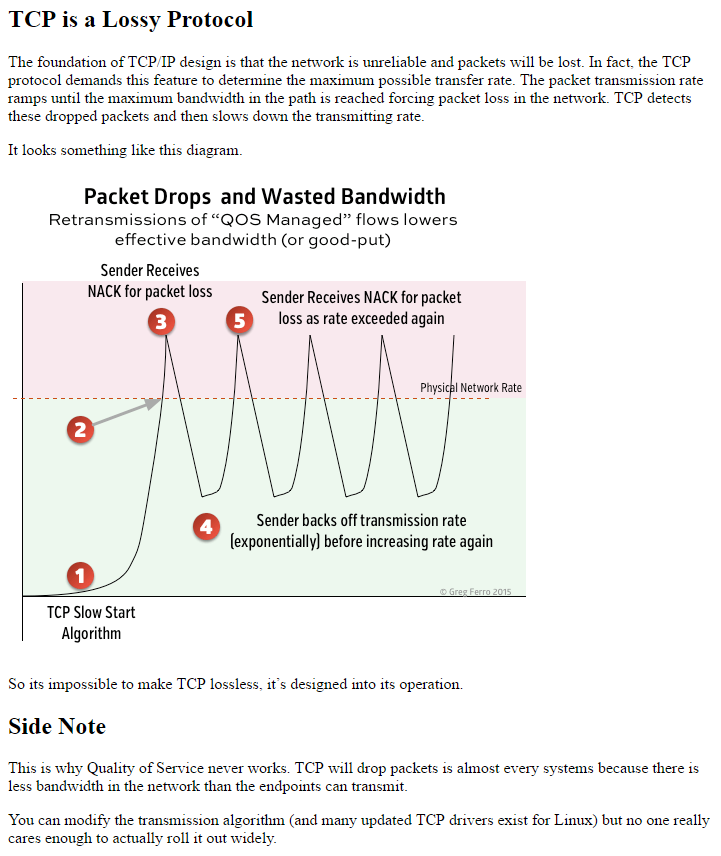
When someone tells you that “TCP is a lossy protocol” during a job interview, don’t throw him out immediately – he was just trusting the Internet a bit too much (click to enlarge).
Everyone has a bad hair day, and it really doesn’t matter who published that text… but if you’re publishing technical information, at least try to do no harm.
Whatever Happened to “Do No Harm”?
A long time ago in a podcast far, far away one of the hosts saddled his pony unicorn and started explaining how stateful firewalls work:
Stateful firewall is a way to imply trust… because it’s possible to hijack somebody’s flows […] and if the application changes its port numbers… my source port changes when I’m communicating with my web server - even though I’m connected to port 80, my source port might change from X to Y. Once I let the first one through, I need to track those port changes […]
WAIT, WHAT? Was that guy really trying to say “someone can change a source port number of an established TCP session”?
Published: Designing Scalable Web Applications
The first batch of the latest materials for my Designing Scalable Web Applications course have been published on my free content web site.