
Category: Data Center
vMotion: an elephant in the Data Center room
A while ago I had a chat with a fellow CCIE (working in a large enterprise network with reasonably-sized Data Center) and briefly described vMotion to him. His response: “Interesting, I didn’t know that.” ... and “Ouch” a few seconds later as he realized what vMotion means from bandwidth consumption and routing perspectives. Before going into the painful details, let’s cover the basics.
Introduction to 802.1Qbb (Priority-based Flow Control — PFC)
Yesterday I wrote that you don’t need DCB technologies to implement FCoE in your network. The FC-BB-5 standard is quite explicit (it also says that 802.1Qbb is the other option):
Lossless Ethernet may be implemented through the use of some Ethernet extensions. A possible Ethernet extension to implement Lossless Ethernet is the PAUSE mechanism defined in IEEE 802.3-2008.
The PAUSE mechanism (802.3x) gives you lossless behavior, but results in undesired side effects when you run LAN and SAN traffic across a converged Ethernet infrastructure.
DCB and TRILL have nothing in common
The emerging Ethernet bridging technologies have been hyped to an extent where the lines between them completely blurred, resulting in statements like “we need DCB and TRILL for FCoE”. Actually, none of that is true, but let’s focus on DCB and TRILL first.
Multihop FCoE 101
The FCoE confusion spread by networking vendors has reached new heights with contradictory claims that you need TRILL to run multihop FCoE (or maybe you don’t) and that you don’t need congestion control specified in 802.1Qau standard (or maybe you do). Allow me to add to your confusion: they are all correct ... depending on how you implement FCoE.
Storage networking is different
The storage industry has a very specific view of the networking protocols – they expect the network to be extremely reliable, either by making it lossless or by using a transport protocol (TCP + embedded iSCSI checksums) that was only recently made decently fast.
Some of their behavior can be easily attributed to network-blindness and attempts to support legacy protocols that were designed for a completely different environment 25 years ago, but we also have to admit that the server-to-storage sessions are way more critical than the user-to-server application sessions.
FCoE and DCB standards
The debate whether the DCB standards are complete or not and thus whether FCoE is a standard-based technology are entering the metaphysical space (just a few more blog posts and they will join the eternal angels-on-a-hairpin problem), but somehow the vendors are not yet talking about the real issues: when will we see the standards implemented in shipping products and will there be a need to upgrade the hardware.
Read more ... (yet again @ etherealmind.com)
I Don’t Need no Stinking Firewall ... or Do I?
Brian Johnson started a lively “I don’t need no stinking firewall” discussion on NANOG mailing list in January 2010. I wanted to write about the topic then, but somehow the post slipped through the cracks… and I’m glad it did, as I’ve learned a few things in the meantime, including the (now obvious) fact that no two data centers are equal (the original debate had to do with protecting servers in large-scale data center).
First let’s rephrase the provocative headline from the discussion. The real question is: do I need a stateful firewall or is a stateless one enough?
Port or Fabric Extenders?
Among other topics discussed during the Big Hot and Heavy Switches (Part 1) podcast (if you haven’t listened to it yet, it’s high time you do), we’ve mentioned port extenders. As our virtual whiteboard is not always clearly visible during the podcast (although we scribble heavily on it), here’s the big-picture architecture:
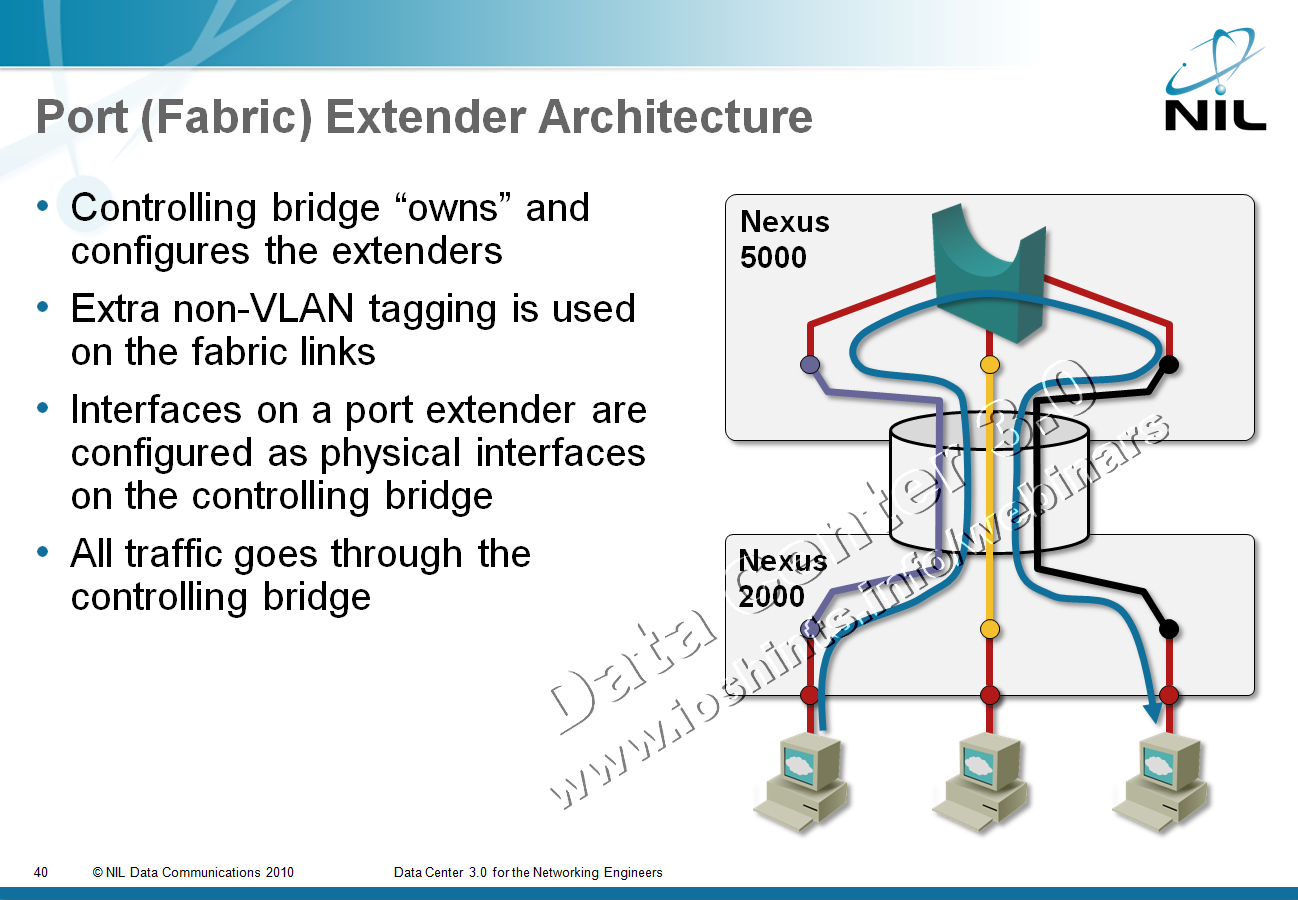
After the podcast I wanted to dig into a few minor technical details and stumbled into a veritable confusopoly.
Packet Filters on a Nexus 7000
We’re always quick to criticize ... and usually quiet when we should praise. I’d like to fix one of my omissions: a few days ago I was trying to figure out whether Nexus 7000 supports IPv6 access lists (one of the presentations I was looking at while researching the details for my upcoming Data Center webinar implied there might be a problem) and was pleasantly surprised by the breadth of packet filters offered on this platform. Let’s start with a diagram.
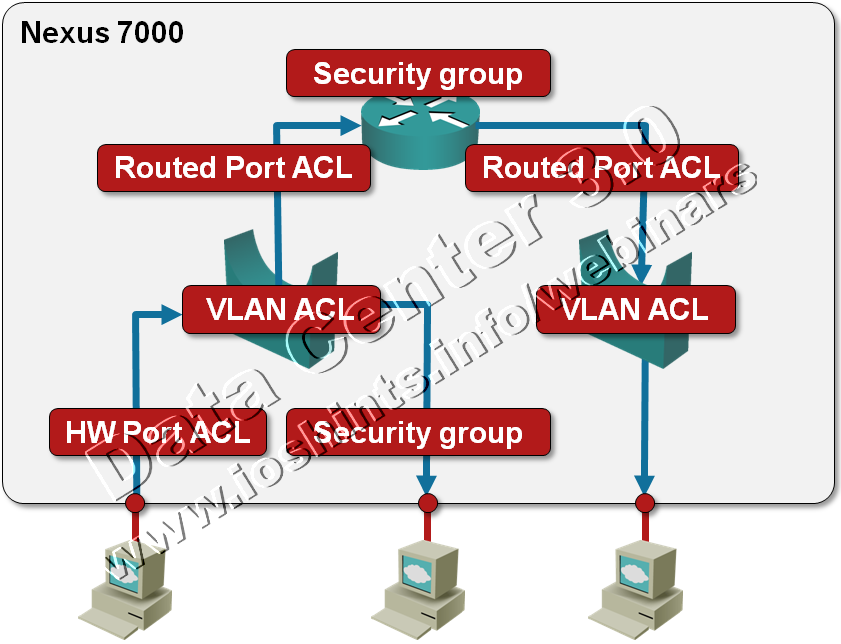
How many large-scale bridging standards do we need?
Someone had a “borderless data center mobility” dream a few years ago and managed to infect a few other people, resulting in a networking industry pandemic that is usually exhibited by the following “facts”:
- Unhindered Virtual Machine mobility across the globe is the absolute prerequisite for any business agility. Wrong. There are other field-proven solutions and although inter-site VM mobility has been demonstrated, it’s still a half-baked idea and has many caveats.
- You can only reach that Holy Grail by extending your layer-2 domains across vast distances. Totally wrong. It would be easier to fix L3 routing and signaling protocols than to invent completely new technologies trying to fix L2 problems. Users of Microsoft NLB are might disagree ... in which case I wish them luck in scaling their architecture.
- Large-scale bridging is absolutely mandatory if you want to build cloud solutions with tens of thousands of servers. Not sure about that. Google is there, Facebook, Twitter and Amazon are (at least) close, large web hosting providers have been around for years ... and yet they somehow managed to survive with existing technologies and good network designs.
Just today XKCD published a very relevant comic, so I can skip my usually sarcastic comments and focus on the plethora of emerging large-scale bridging standards and implementations. Let’s walk through them: