
Category: MPLS
EVPN/MPLS Bridging Forwarding Model
Most networking engineers immediately think about VXLAN and data center switches when they hear about EVPN. While that’s the most hyped use case, EVPN standardization started in 2012 as a layer-2 VPN solution on top of MPLS transport trying to merge the best of VPLS and MPLS/VPN worlds.
If you want to understand how any technology works, and what its quirks are, you have to know how it was designed to be used. In this blog post we’ll start that journey exploring the basics of EVPN used in a simple MLPS network with three PE-routers:
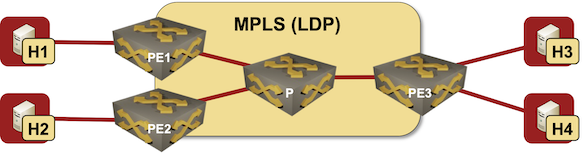
Lab topology
Opinion: Do You Care about MPLS in 2022?
One of my readers asked for my opinion about this question…
… and I promised something longer than 280 characters.
BGP Labeled Unicast Interoperability Challenges
Jeff Tantsura left me tantalizing hint after reading the BGP Labeled Unicast on Cisco IOS blog post:
Read carefully “Relationship between SAFI-4 and SAFI-1 Routes” section in RFC 8277
The start of that section doesn’t look promising (and it gets worse):
It is possible that a BGP speaker will receive both a SAFI-11 route for prefix P and a SAFI-42 route for prefix P. Different implementations treat this situation in different ways.
Now for the details:
netlab MPLS Support
netlab release 1.2.0 adds full-blown MPLS and MPLS/VPN support:
- VRF definitions and layer-3 VRFs
- VRF-aware OSPF, IS-IS and BGP
- Traditional MPLS with LDP (SR-MPLS was already available)
- BGP Labeled Unicast
- MPLS/VPN: VPNv4 and VPNv6 address family support
It’s never been easier to build full-blown MPLS/VPN labs ;)… if you’re OK with using Cisco IOS or Arista EOS. Please feel free to submit a PR to add support for other platforms.
You might want to start with the VRF tutorial to see how simple it is to define VRFs, and follow the installation guide to set up your lab – if you’re semi-fluent in Linux, the easiest option would be to run Arista cEOS.
BGP Labeled Unicast on Arista EOS
A week ago I described how Cisco IOS implemented BGP Labeled Unicast. In this blog post we’ll focus on Arista EOS using the same lab as before:
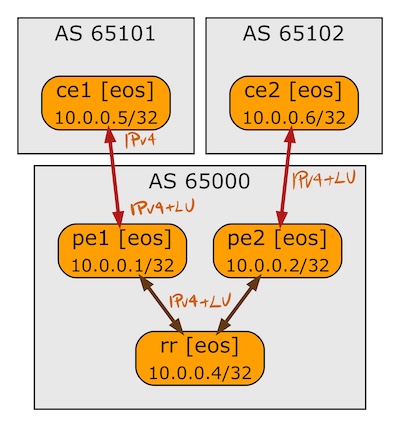
BGP sessions in the BGP-LU lab
BGP Labeled Unicast on Cisco IOS
While researching the BGP RFCs for the Three Dimensions of BGP Address Family Nerd Knobs, I figured out that the BGP Labeled Unicast (BGP-LU, advertising MPLS labels together with BGP prefixes) uses a different address family. So far so good.
Now for the intricate bit: a BGP router might negotiate IPv4 and IPv4-LU address families with a neighbor. Does that mean that it’s advertising every IPv4 prefix twice, once without a label, and once with a label? Should that be the case, how are those prefixes originated and how are they stored in the BGP table?
As always, the correct answer is “it depends”, this time on the network operating system implementation. This blog post describes Cisco IOS behavior, a follow-up one will focus on Arista EOS.
MPLS/LDP Creation Myths
Hannes Gredler wrote an interesting comment to my Segment Routing vs LDP in Hub-and-Spoke Networks blog post:
In 2014 when I did the first prototype implementation of MPLS-SR node labels, I was stunned that just with an incremental add of 500 lines of code to the vanilla IPv4/IPv6 IS-IS codebase I got full any-to-any connectivity, no sync issues, no targeted sessions for R-LFA …. essentially labeled transport comes for free.
Based on that, one has to wonder “why did we take the LDP detour and all the complexity it brings?”. Here’s what Hannes found out:
… updated on Friday, March 18, 2022 07:02 UTC
Hub-and-Spoke VPLS: Revenge of LDP
In the Segment Routing vs LDP in Hub-and-Spoke Networks blog post I explained why you could get into interesting scaling issues when running MPLS with LDP in a large hub-and-spoke network, and how you can use Segment Routing (MPLS edition) to simplify your design.
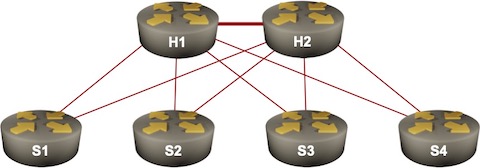
Sample hub-and-spoke network
Now imagine you’d like to offer VPLS services between hubs and spokes, and happen to be using equipment that uses targeted LDP sessions to signal pseudowires. Guess what happens next…
Segment Routing vs LDP in Hub-and-Spoke Networks
I got an interesting question that nicely illustrates why Segment Routing (the MPLS variant) is so much better than LDP. Imagine a redundant hub-and-spoke network with hundreds of spokes. Let’s settle on 500 spokes – IS-IS supposedly has no problem dealing with a link-state topology of that size.
Let’s further assume that all routers advertise only their loopbacks1 and that we’re using unnumbered hub-to-spoke links to minimize the routing table size. The global routing table thus contains ~500 entries. MPLS forwarding tables (LFIB) contain approximately as many entries as each router assigns a label to every prefix in the routing table2. What about the LDP table (LIB – Label Information Base)?
… updated on Monday, January 31, 2022 19:26 UTC
Sample Lab: Traffic Engineering with SR-MPLS on Junos and SR Linux
Last week I published a link to Pete Crocker’s RSVP-TE lab, but there’s more: he created another lab using the same topology that uses SR-MPLS with IS-IS to get the job done.