
Category: MPLS VPN
MPLS/VPN in Data Center Interconnect (DCI) Designs
Yesterday I was describing a dreamland in which hypervisor switches would use MPLS/VPN to implement seamless scalable VM mobility across IP+MPLS infrastructure. Today I’ll try to get down to earth; there are exciting real-life design using MPLS/VPN between data centers. You can implement them with Catalyst 6500/Cisco 7600 or ASR1K and will soon be able to do the same with Nexus 7000.
Most data centers have numerous security zones, from external network, DMZ, web servers and applications servers to database servers, IP-based storage and network management. When you design active/active data centers, you want to keep the security zones strictly separate and the “usual” solution proposed by L2-crazed crowd is to bridge multiple VLANs across the DCI infrastructure (in the next microsecond they start describing the beauties of their favorite L2 DCI technology).
(v)Cloud Architects, ever heard of MPLS?
Duncan Epping, the author of fantastic Yellow Bricks virtualization blog tweeted a very valid question following my vCDNI scalability (or lack thereof) post: “What you feel would be suitable alternative to vCD-NI as clearly VLANs will not scale well?”
Let’s start with the very basics: modern data center switches support anywhere between 1K and 4K (the theoretical limit based on 802.1q framing) VLANs. If you need more than 1K VLANs, you’ve either totally messed up your network design or you’re a service provider offering multi-tenant services (recently relabeled by your marketing department as IaaS cloud). Service Providers had to cope with multi-tenant networks for decades ... only they haven’t realized those were multi-tenant networks and called them VPNs. Maybe, just maybe, there’s a technology out there that’s been field-proven, known to scale, and works over switched Ethernet.
MPLS/VPN-over-GRE-over-IPSec: Does It Really Work?
Short answer: yes, it does.
During the geeky chat we had just after we’d finished recording the Data Center Fabric Packet Pushers podcast, Kurt (@networkjanitor) Bales asked me whether the MPLS/VPN-over-DMVPN scenarios I’m describing in Enterprise MPLS/VPN Deployment webinar really work (they do seem a bit complex).
I always test the router configurations I use in my webinars and I usually share them with the attendees. Enterprise MPLS/VPN Deployment webinar includes a complete sets of router configurations covering 10 scenarios, including five different MPLS/VPN-over-DMVPN designs, so you can easily test them in your lab and verify that they do work. But what about a live deployment?
VRF-aware services in Cisco IOS
"Which Cisco IOS services work in a VRF?" is the question I get in almost any VRF-related discussion, so I made sure it’s covered very early in my Enterprise MPLS/VPN deployment webinar. This is the explanation I usually give in the webinar:
Load sharing in MPLS/VPN networks with route reflectors
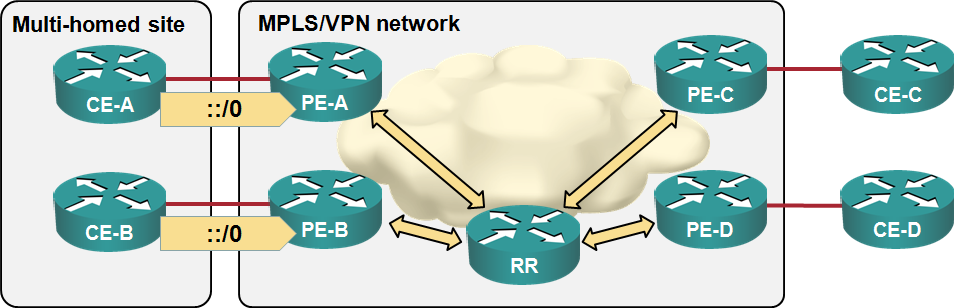
Some of the e-mails and comments I received after writing the “Changing VPNv4 route attributes” post illustrated common MPLS/VPN misconceptions, so it’s worth addressing them in a series of posts. Let’s start with the simplest scenario: load balancingsharing toward a multi-homed customer site. We’ll use a very simple MPLS/VPN network with three customer sites, four CE-routers, four PE-routers a route reflector:
Changing VPNv4 route attributes within the MPLS/VPN network
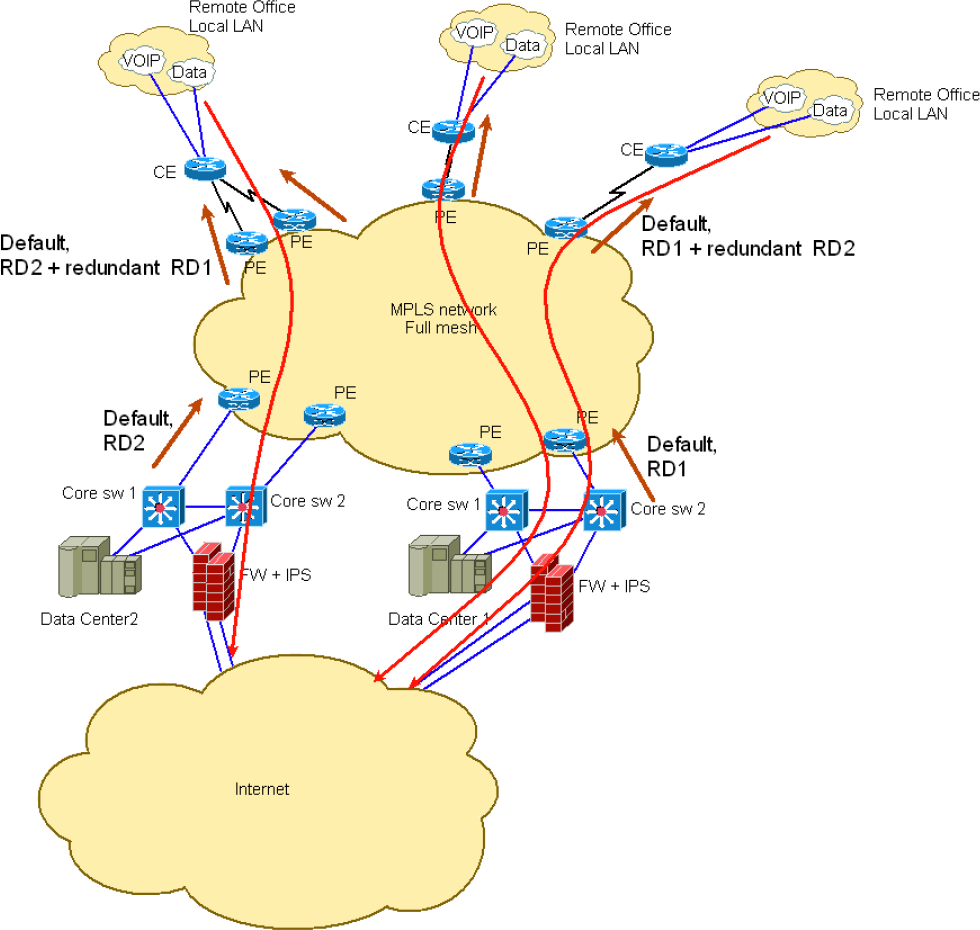
John (not a real name for obvious reasons) sent me an interesting challenge after attending my Enterprise MPLS/VPN Deployment webinar. He’s designed an MPLS/VPN network approximated by the following diagram:
End-to-End QoS marking in MPLS/VPN-over-DMVPN networks
I got a great question in one of my Enterprise MPLS/VPN Deployment webinars when I was describing how you could run MPLS/VPN across DMVPN cloud:
That sounds great, but how does end-to-end QoS work when you run IP-over-MPLS-over-GRE-over-IPSec-over-IP?
My initial off-the-cuff answer was:
Well, when the IP packet arriving through a VRF interface gets its MPLS label, the IP precedence bits from the IP packet are copied into the MPLS EXP (now TC) bits. As for what happens when the MPLS packet gets encapsulated in a GRE packet and when the GRE packet is encrypted… I have no clue. I need to test it.
MPLS/VPN over mGRE strikes again
More than five years after the MPLS/VPN-in-mGRE encapsulation was standardized (add a few more years for the work-in-progress and IETF draft stages), it finally debuted in a mainstream-wannabe IOS release running on ISR routers (15.1(2)T), making it usable for the enterprise WAN designers, who are probably its best target audience.
I was writing about the two conflicting MPLS/VPN over mGRE implementations a while ago and got the impression the Service Providers aren’t too excited about this option. No wonder – most of them use full-blown MPLS backbones, so they have no need for GRE tunnels.
Campfire: the true story of MPLS
Just before 2010 disappeared, a tweet by my friend Greg @etherealmind Ferro triggered a minor twitstorm. He wrote:
If we had implemented IPv6 ten years ago, would we have MPLS today? I think not.
His tweet contains two major misconceptions:
- MPLS was designed to implement layer-3 VPN services;
- We wouldn’t need VPNs if everyone would be using global IPv6 addresses.
I’ll focus on the first one today; the inaccuracy of the second one is obvious to anyone who was asked to implement MPLS VPNs in enterprise networks to ensure end-to-end path separation between departments or users with different security levels.
Where Would You Need GRE?
After I made the “duct tape of networking” joke, I quickly became a GRE lover (according to @Neelixx – another Twitter account lost in the mists of time). Jokes aside, let’s see where it makes sense to use GRE.