
The Data Center Fabric architectures
Have you noticed how quickly fabric got as meaningless as switching and cloud? Everyone is selling you data center fabric and no two vendors have something remotely similar in mind. You know it’s always more fun to look beyond white papers and marketectures and figure out what’s really going on behind the scenes (warning: you might be as disappointed as Dorothy was). I was able to identify three major architectures (at least two of them claiming to be omnipotent fabrics).
Business as usual
Each networking device (let’s confuse everyone and call them switches) works independently and remains a separate management and configuration entity. This approach has been used for decades in building the global Internet and thus has proven scalability. It also has well-known drawbacks (large number of managed devices) and usually requires thorough design to scale well.
DHCPv6-RADIUS integration: the Cisco way
Yesterday I described how the IPv6 architects split the functionality of IPCP into three different protocols (IPCPv6, RA and DHCPv6). While the split undoubtedly makes sense from the academic perspective, the service providers offering PPP-based services (including DSL and retrograde uses of PPP-over-FTTH) went berserk. They were already using RADIUS to authenticate PPP users ... and were not thrilled by the idea that they should deploy DHCPv6 servers just to make the protocol stack look nicer.
IPv6CP+DHCPv6+SLAAC+RA = IPCP
Last week I got an interesting tweet: “Hey @ioshints can you tell me what is the radius parameter to send ipv6 dns servers at pppoe negotiation?” It turned out that the writer wanted to propagate IPv6 DNS server address with IPv6CP, which doesn’t work. Contrary to IPCP, IPv6CP provides just the bare acknowledgement that the two nodes are willing to use IPv6. All other parameters have to be negotiated with DHCPv6 or ICMPv6 (RA/SLAAC).
The following table compares the capabilities of IPCP with those offered by a combination of DHCPv6, SLAAC and RA (IPv6CP is totally useless as a host parameter negotiation tool):
Traffic Trombone (what it is and how you get them)
Every so often I get a question “what exactly is a traffic trombone/tromboning”. Here’s my attempt at a semi-formal definition.
Traffic trombone is a term (probably invented by Greg Ferro) that colorfully describes inter-VLAN traffic flows in a network with stretched (usually overlapping) L2 domains.
In a traditional L2/L3 data center architecture with small L2 domains in the access layer and L3 forwarding across the core network, the inter-subnet traffic flows were close to optimal: a host would send a packet toward the first-hop (ingress) router (across a bridged L2 subnet), the ingress router would forward the packet across an optimal path toward the egress router, and the egress router would deliver the packet (yet again, across a bridged L2 subnet) to the destination host.
What exactly makes something “mission critical”?
Pete Welcher wrote an excellent Data Center L2 Interconnect and Failover article with a great analogy: he compares layer-2 data center interconnect to beer (one might be a good thing, but it rarely stops there). He also raised an extremely good point: while it makes sense to promote load balancers and scale-out architectures, many existing applications will never run on more than a single server (sometimes using embedded database like SQL Express).
L2 DCI with MLAG over VPLS transport?
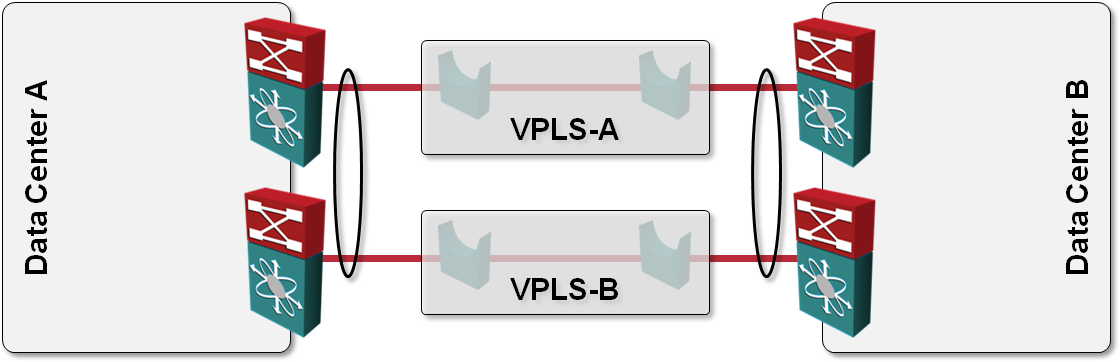
One of the answers I got to my “How would you use VPLS transport in L2 DCI” question was also “Can’t you just order two VPLS services, use them as P2P links and bundle the two links into a multi-chassis link aggregation group (MLAG)?” like this:
Looking for vCDNI packet traces
One of the things I wanted to test in my UCS lab was the vCloud Director; I was interested in the details of the MAC-in-MAC implementation used by vCDNI. Unfortunately vCD requires an Oracle database and I simply didn’t have enough time to set that up. If you have vCD up and running and use vCDNI to create isolated networks, I would appreciate if you could take a few packet traces of traffic exchanged between VMs running on different ESX servers and send them to me. What I would need most are examples of:
Yearly subscription now available without a webinar registration
Some of my readers wanted to buy the yearly subscription but couldn’t decide which webinar to register for first (the yearly subscription was sold as webinar tickets). Fortunately the database structure I used for recordings turned out to be easily extendable; you can now buy the yearly subscription directly from my website with Google Checkout.
The amount of the material you get with the yearly subscription is also growing: you get access to recordings of sixteen webinars (and growing), all corresponding PDFs and well over 150 router configurations ... plus unlimited access to all live webinar sessions for the duration of your subscription.
DHCPv6+SLAAC+RA = DHCPv4
We all know that IPv6 handles host network parameter initialization a bit different than IPv4 (where we usually use DHCP), but the details could still confuse you if you’re just entering the IPv6 world.
A typical LAN-attached hosts needs its own address as well as the addresses of the default router and DNS server. DHCPv4 provides all three; in the IPv6 world you need two or three protocols as summarized in the following table
How would you use VPLS transport in L2 DCI?
One of the questions answered in my Data Center Interconnect webinar is: “what options do I have to build a layer-2 interconnect with transport technology X”, with X ∈ {dark-fiber, DWDM, SONET, pseudowire, VPLS, MPLS/VPN, IP}. VPLS is one of the tougher nuts to crack; it provides a switched LAN emulation, usually with no end-to-end spanning tree (which you wouldn’t want to have anyway).
Imagine the following simple scenario where we want to establish redundant connectivity between two data centers and the only transport technology we can get is VPLS (or some other Carrier Ethernet LAN service):