
Published on , commented on July 9, 2022
Fallacies of GUI
I love Greg Ferro’s characterization of CLI:
We need to realise that the CLI is a “power tools” for specialist tradespeople and not a “knife and fork” for everyday use.
However, you do know that most devices’ GUI offers nothing more than what CLI does, don’t you? Where’s the catch?
Summer seems to have arrived
The current weather around Central Europe doesn’t exactly support this conclusion, but I do get many more “I’m on vacation” responses than usual, so it’s time to reduce the blogging frequency to keep your RSS reader from overloading (you did switch from Google Reader to something like Feedly, didn’t you?).
However, if you’re looking for some really heavy reading, do pick up The Hidden Reality and explore various multiverse proposals. There’s also a beach-friendly version of multiverse discussion: The Long Earth by the one-and-only Terry Pratchett.
Data Center Fabrics Built with Plexxi Switches
During the recent Data Center Fabrics Update webinar Dan Backman from Plexxi explained how their innovative use of CWDM technology and controller-assisted forwarding simplifies deployment and growth of reasonably-sized data center fabrics.
I would highly recommend that you watch the video – the start is a bit short on details, but he does cover all the juicy aspects later on.
Real-Life SDN/OpenFlow Applications
NEC and a slew of its partners demonstrated an interesting next step in the SDN saga @ Interop Las Vegas 2013: multi-vendor SDN applications. Load balancing, orchestration and security solutions from A10, Silver Peak, Red Hat and Radware were happily cooperating with ProgrammableFlow controller.
A curious mind obviously wants to know what’s behind the scenes. Masterpieces of engineering? Large integration projects ... or is it just a smart application of API glue? In most cases, it’s the latter. Let’s look at the ProgrammableFlow – Radware integration.
The Tools That I Use (Webinars)
Andreas was watching my recent Enterasys DCI webinar and got intrigued by the quick hand drawings I made, so he asked me “What kind of tool do you use to make the hand drawings during your presentations? It must be something different than a mouse.”
In case you weren’t watching one of my recent webinars, here’s a sample to get you started:
CLI and API Myths
Greg Ferro published a great blog post explaining why he decided to use node.js to build his cloud automation platform. While I agree with most things he wrote, this one prickled me the wrong way:
In my view, an Application Programmable Interface(API) is the fundamental change that makes Software Defined Networking (SDN) a “thing”. We need to realise that the CLI is a “power tools” for specialist tradespeople and not a “knife and fork” for everyday use.
While I agree with his view on CLI, keep in mind that API is no different.
EIBGP Load Balancing
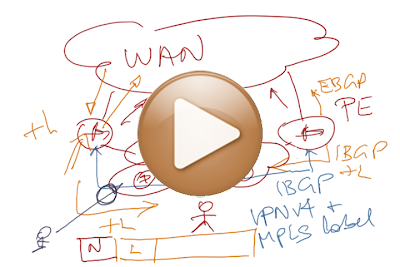
The next small step in my MPLS/VPN update project: EIBGP load balancing – why is it useful, how it works, why can’t you use it without full-blown MPLS/VPN, and what the alternatives are.
MPLS/VPN Carrier’s Carrier – Myth or Reality?
Andrew is struggling with MPLS/VPN providers and sent me the following question:
Is "carriers carrier" a real service? I'm having a bit of an issue at the moment with too many MPLS providers […] Carrier’s carrier would be an answer to many of them, but none of the carriers admit to being able to do this, so I was wondering if it's simply that I'm speaking to the wrong people, or whether they really don't...
Short answer: I have yet to see this particular unicorn roaming the meadows of reality.
Arista EOS Virtual ARP (VARP) Behind the Scenes
In the Optimal L3 Forwarding with VARP and Active/Active VRRP blog post I made a remark along the lines of “Things might get nasty [in Arista EOS Virtual ARP world] if you have configuration mismatches”, resulting in a lengthy and amazingly insightful email exchange with Lincoln Dale during which we ventured deeper and deeper down the Virtual ARP (VARP) rabbit hole. Here’s what I learned during out trip:
Implementing Control-Plane Protocols with OpenFlow
The true OpenFlow zealots would love you to believe that you can drop whatever you’ve been doing before and replace it with a clean-slate solution using dumbest (and cheapest) possible switches and OpenFlow controllers.
In real world, your shiny new network has to communicate with the outside world … or you could take the approach most controller vendors did, decide to pretend STP is irrelevant, and ask people to configure static LAGs because you’re also not supporting LACP.