
Category: MPLS VPN
… updated on Tuesday, December 29, 2020 09:34 UTC
Limitations of VRF Routing Protocols on Cisco IOS
Cisco IOS allows up to 32 routing protocols contributing routes into a routing table (two of them are always connected and static). The limitation applies to the global routing table as well as to each individual VRF; the architectural reason for the limit is a 32-bit mask that’s used in Cisco IOS to mark individual routing protocols. The routing protocol ID (as displayed by the show ip protocol summary command) is thus limited to values 0 to 31. With value 0 being reserved for connected routes and value 1 for static routes, 30 values are left to number the routing protocols.
Due to the implementation details of Cisco IOS, the BGP, RIP and each EIGRP routing process consume routing protocol ID in all VRFs (regardless of whether they are used or not). You can view the IDs of individual routing protocols with the show ip protocol [vrf name] summary command.
True or false: MPLS VPNs offer equivalent security to Frame Relay
Years ago when vendors were pushing the MPLS story to Service Providers, an “independent analyst” wrote a report claiming that MPLS-based VPNs offer security equivalent to Frame Relay networks (to find those reports, ask Google about “MPLS security equivalent to Frame Relay”). This might be true from the functional perspective (and it’s absolutely true that using IP does not make MPLS-based VPNs inherently insecure), but anyone believing these reports might become mightily upset when learning about BGP and MPLS security issues.
Before going any further, please note that exploiting the MPLS architecture as described in All your packets are belong to us presentation requires access to the core SP network, which means that the network (or network management station) has already been successfully penetrated.
I hope you knew this already: Backbone-hacking tools
A few days ago (the) Steve Bellowin sent an e-mail to the NANOG mailing list pointing to a FUD-full article describing upcoming release of MPLS hacking tools. Christian Koch quickly pointed out a similar presentation given by the same group @ Schmoocon and numerous respondents correctly stated these are old issues … if you’re interested in BGP and MPLS security, of course. Nicolas Fischbach even provided link to a 7 year old presentation describing numerous BGP/IGP/MPLS risks and attack vectors.
Build a VPN Across Your IP Network with Multi-VRF Feature
One of our customers had to provide end-to-end IP transport across their enterprise network for an outsourced video surveillance solution. We implemented a true VPN solution for them (the hosts in the enterprise network cannot access the surveillance equipment and vice versa) using the Multi-VRF feature available in all recent Cisco IOS releases.
I described the solution Add a VPN to an Enterprise Network with Multi-VRF Functionality article; you’ll find it somewhere in this list.
Extranet with Overlapping Addresses
The idea to write an article describing how you can use MPLS VPN-enabled NAT to implement flexible extranets that allow participants to retain their existing (and sometimes overlapping) IP address space has been sitting in my to-do list for over a year.
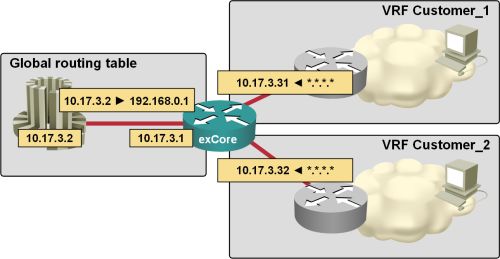
After I’ve finally written it (without even hinting what I’ve been working on), I got several e-mails from my readers asking the questions this article answers, so it looks like the topic has suddenly become very hot. Do you have any ideas why that would be the case?
MPLS support on 1800-series routers
Christoph sent me an interesting question a few days ago:
I played a bit arround with 2 Cisco 1803 and I found MPLS related configurations commands in IOS 12.4(15)T (Advanced Enterprise) on this box. MPLS was not listed as a included fearture in the Cisco Feature Navigator for this image and some searching at cisco.com took me to a 2 year old document telling me that MPLS isn't supported on this series. Some more searching took me back to the Cisco Feature Navigator which lists MPLS as feature for the Cisco 1805 router (which uses the same IOS image, afaik).
So, I'm a bit confused now if MPLS is really working / supported on the low-end Cisco ISR 1800 fixed series?
MPLS was mostly available but never supported on low-end platforms (including Cisco 2600). In those days I've taken some heat for reusing existing 2600-based labs to teach Cisco-internal MPLS courses (since we were teaching the students to configure unsupported devices :).
Do you need LDP with MPLS TE?
An anonymous commenter to my implicit NULL/PHP post made a very valid point:
Most Cisco documentation states that you must enable LDP before doing MPLS-TE, which is a complete fallacy.
If you're using MPLS TE simply to shift IP traffic around your network, he's absolutely right: there is no need to run LDP if you have an IP-only network. If you're running MPLS VPN or BGP on edges/MPLS in the core, the answer becomes “it depends.”
… updated on Monday, December 28, 2020 18:03 UTC
PE-to-PE Troubleshooting in MPLS VPN Networks
End-to-end troubleshooting of MPLS VPN solutions is one of the more complex network troubleshooting tasks. On top of several sophisticated technologies and protocols used in MPLS VPN solutions, we have to deal with customer-to-provider interaction on the IP routing protocol level, which makes the troubleshooting efforts even more convoluted.
To minimize the impact of your customers on your troubleshooting efforts, you might want to start with the PE-to-PE troubleshooting. When used as the first step in your troubleshooting process, the PE-PE tests will bypass customer errors, intra-site customer routing problems, PE-CE interactions, and route redistribution issues.
OSPF in a VRF Requires a Box-Unique Router ID
It’s obvious why two routers in the same OSPF domain cannot have the same router ID. However, requiring unique router IDs on OSPF processes running in different VRFs is probably too harsh, even though it does prevent confusion if two VRFs ever get connected through a customer site. Anyhow, if you have overlapping IP addresses on loopback interfaces in different VRFs, OSPF process might not start.
… updated on Saturday, May 20, 2023 09:51 UTC
Multihomed EIGRP Sites in MPLS VPN Network
Deploying EIGRP as the PE-CE routing protocol in MPLS VPN networks is easy if all sites have a single PE-CE link and there are no backdoor links between the sites. Real life is never as simple as that; you have to cope with various (sometimes undocumented) network topologies. Even that would be manageable if the customer networks would have a clean addressing scheme that would allow good summarization (that happens once in a blue moon) or if the MPLS VPN core could announce the default route into the EIGRP sites (wishful thinking; the customer probably has one or more Internet exit points).