
Category: IP Routing
DHCP Relaying Details
Chinar Trivedi asked an interesting question about DHCP relaying in VXLAN/EVPN world on Twitter and my first thought was “that shouldn’t be hard” but when I read the first answer that turned into “wait a minute, how exactly does DHCP relaying works?”
I’m positive there’s a tutorial out there somewhere, but I decided to go back to the sources of wisdom: the RFCs. It turned out to be a long walk down the IETF history lane.
Video: Link State Routing Protocol Basics
The Routing Protocols Overview part of How Networks Really Work webinar introduced the concepts of distance-vector and link-state routing protocols. Next step: the basics of link-state routing protocols.
IRB Models: Edge Routing
The simplest way to implement layer-3 forwarding in a network fabric is to offload it to an external device1, be it a WAN edge router, a firewall, a load balancer, or any other network appliance.
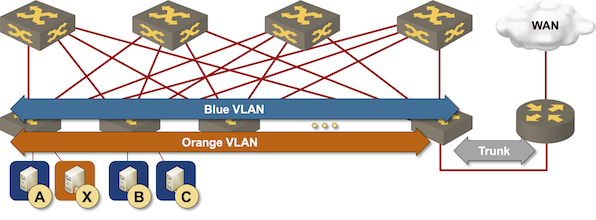
Routing at the (outer) edge of the fabric
Worth Reading: Routing Protocol Implementation Evaluation
In 2018 I tried to figure out whether the rush to deploy new routing protocols in leaf-and-spine fabrics is anything more than another blob of hype (RIFT, OpenFabric, BGP), considering OSPF got the job done for AWS. Those discussions probably sounded like a bunch of smart kids trying to measure outside temperature with a moist finger, so the only recommendation I could give in 2021 was “use the best tool for the job, keeping in mind you’re not Google or Microsoft”
Running Routing Protocols over MLAG Links
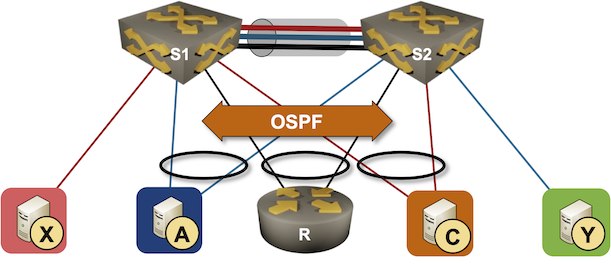
It took vendors like Cisco years to start supporting routing protocols between MLAG-attached routers and a pair of switches in the MLAG cluster. That seems like a no-brainer scenario, so there must be some hidden complexities. Let’s figure out what they are.
We’ll use the familiar MLAG diagram, replacing one of the attached hosts with a router running a routing protocol with both members of the MLAG cluster (for example, R, S1, and S2 are OSPF neighbors).
… updated on Thursday, December 1, 2022 16:30 UTC
ICMP Redirects and Suboptimal Routing
A while ago, I wrote a blog post explaining why we should (mostly) disable ICMP redirects, triggering a series of comments discussing the root cause of ICMP redirects. A few of those blamed static routes, including:
Put another way, the presence or absence of ICMP Redirects is a red herring, usually pointing to architectural/design issues instead. In this example, using vPC Peer Gateway or, better yet, running a minimal IGP instead of relying on static routes eliminates ICMP Redirects from both the problem and solution spaces simultaneously.
Unfortunately, that’s not the case. You can get suboptimal routing that sometimes triggers ICMP redirects in well-designed networks running more than one routing protocol.
Integrated Routing and Bridging (IRB) Design Models
Imagine you built a layer-2 fabric with tons of VLANs stretched all over the place. Now the users want to exchange traffic between those VLANs, and the obvious question is: which devices should do layer-2 forwarding (bridging) and which ones should do layer-3 forwarding (routing)?
There are four typical designs you can use to solve that challenge:
- Exchange traffic between VLANs outside of the fabric (edge routing)
- Route on core switches (centralized routing)
- Route on ingress (asymmetric IRB)
- Route on ingress and egress (symmetric IRB)
This blog post is an overview of the design models; we’ll cover each design in a separate blog post.
Video: Routing Protocols Overview
After discussing network addressing and switching, routing, and bridging in the How Networks Really Work webinar, it was high time for a deep dive into routing protocols, starting (as always) with an overview.
Must Read: Routing Will Never Be a Solved Problem
Mark Seery wrote a fantastic must-read article explaining why routing will never be a solved problem.
You might want to enjoy it as a relaxing antidote after a painful exposure to SD-WAN (or SD-something-else) brainwashing.
… updated on Tuesday, March 11, 2025 13:48 +0100
VLAN Interfaces and Subinterfaces
Early bridges implemented a single bridging domain across all ports. Within a few years, we got multiple bridging domains within a single device (including bridging implementation in Cisco IOS). The capability to have multiple bridging domains stretched across several devices was still missing… until the modern-day Pandora opened the VLAN box and forever swamped us in the complexities of large-scale bridging.