
Real-Life Not-Exactly-Networking AI Use Case
I get several emails every week1 from people I never heard of telling me what a wonderful job they could do writing guest blog posts on a range of topics of interest to my audience.
I’m positive you must be pretty intelligent to be a successful scammer, so I’m sure the good ones are using ChatGPT to generate the “unique” content they’re promising. I felt it was high time to return the favor.
Response: Nothing Works (in Enterprise IT)
Dmitry Perets left a thoughtful comment on my Nothing Works blog post describing why enterprise IT might be even worse than consumer world.
I think another reason for the “Nothing Works” world is that the only true Management Plane separation that exists in our industry is that of the real “human” management. In the medium/large enterprises they (and their interests, KPIs and so on) are very much separated from the technical workforce. And increasingly so, because today the technical workforce might not even be the employees of the same enterprise. They are likely to come from some IT consultancy outsource – degree of separation which makes a true SDN evangelist envious.
Improve BGP Startup Time on Cisco IOS
I like using Cisco IOS for my routing protocol virtual labs1. It uses a trivial amount of memory2 and boots relatively fast. There was just one thing that kept annoying me: Cisco IOS release 15.x takes forever to install local routes in the BGP table and even longer to select the best routes and propagate them3.
I finally found the culprit: bgp update-delay nerd knob. Here’s what the documentation has to say about it:
Mix Containers and VMs with netlab Release 1.5.0
Maybe it’s just me, but I always need a few extra devices in my virtual labs to have endpoints I could ping to/from or to have external routing information sources. We used VRF- and VLAN tricks in the days when we had to use physical devices to carve out a dozen hosts out of a single Cisco 2501, and life became much easier when you could spin up a few additional virtual machines in a virtual lab instead.
Unfortunately, those virtual machines eat precious resources. For example, netlab allocates 1GB to every Linux virtual machine when you only need bash and ping. Wouldn’t it be great if you could start that ping in a busybox container instead?
Worth Reading: 2 Mpps on a Pentium CPU
Robert Graham published a blog post describing how his IDS/IPS system handled 2 Mpps on a Pentium III CPU 20 years ago… and yet some people keep claiming that “Driving a 100 Gbps network at 80% utilization in both directions consumes 10–20 cores just in the networking stack” (in 2023). I guess a suboptimal-enough implementation can still consume all the CPU cycles it can get and then some.
Video: Migrating into a Cloud
Matthias Luft concluded his part of Introduction to Cloud Computing webinar with a case study: how can you migrate an existing workload into a cloud environment?
IRB Models: Edge Routing
The simplest way to implement layer-3 forwarding in a network fabric is to offload it to an external device1, be it a WAN edge router, a firewall, a load balancer, or any other network appliance.
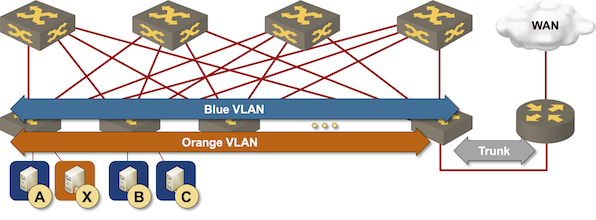
Routing at the (outer) edge of the fabric
Response: Complexities of Network Automation
David Gee couldn’t resist making a few choice comments after I asked for his opinion of an early draft of the Network Automation Expert Beginners blog post, and allowed me to share them with you. Enjoy 😉
Network automation offers promises of reliability and efficiency, but it came without a warning label and health warnings. We seem to be perpetually stuck in a window display with sexily dressed mannequins.
Design Clinic: Small-Site IPv6 Multihoming
I decided to stop caring about IPv6 when the protocol became old enough to buy its own beer (now even in US), but its second-system effects keep coming back to haunt us. Here’s a question I got for the February 2023 ipSpace.net Design Clinic:
How can we do IPv6 networking in a small/medium enterprise if we’re using multiple ISPs and don’t have our own IPv6 Provider Independent IPv6 allocation. I’ve brainstormed this with people far more knowledgeable than me on IPv6, and listened to IPv6 Buzz episodes discussing it, but I still can’t figure it out.
netlab Release 1.5.0: Larger Lab Topologies
netlab release 1.5.0 includes features that will help you start very large lab topologies (someone managed to run over 90 Mikrotik routers on a 24-core server):
- You can start libvirt virtual machines in batches to reduce the CPU overload that causes startup failures on large topologies.
- You can combine virtual machines and containers in the same lab, further reducing the memory footprint for devices available as true containers (Linux hosts, Cumulus/FRR routers, Arista cEOS)
- Use custom management network IP subnet if you’re running out of management IP addresses
To get more details and learn about additional features included in release 1.5.0, read the release notes. To upgrade, execute pip3 install --upgrade networklab.