
We should teach the network how to serve the applications. Really?
In a recent blog post Marten Terpstra wrote:
We are teaching our applications how to behave uniformly. Or normal. And that's not normal. We should teaching the network how to serve the applications instead. However demanding or quirky they decide to be.
That’s definitely a noble engineering goal, the “only” problem is that I don’t know many customers who would be willing to foot the bill.
Control Plane Protocols in Overlay Virtual Networks
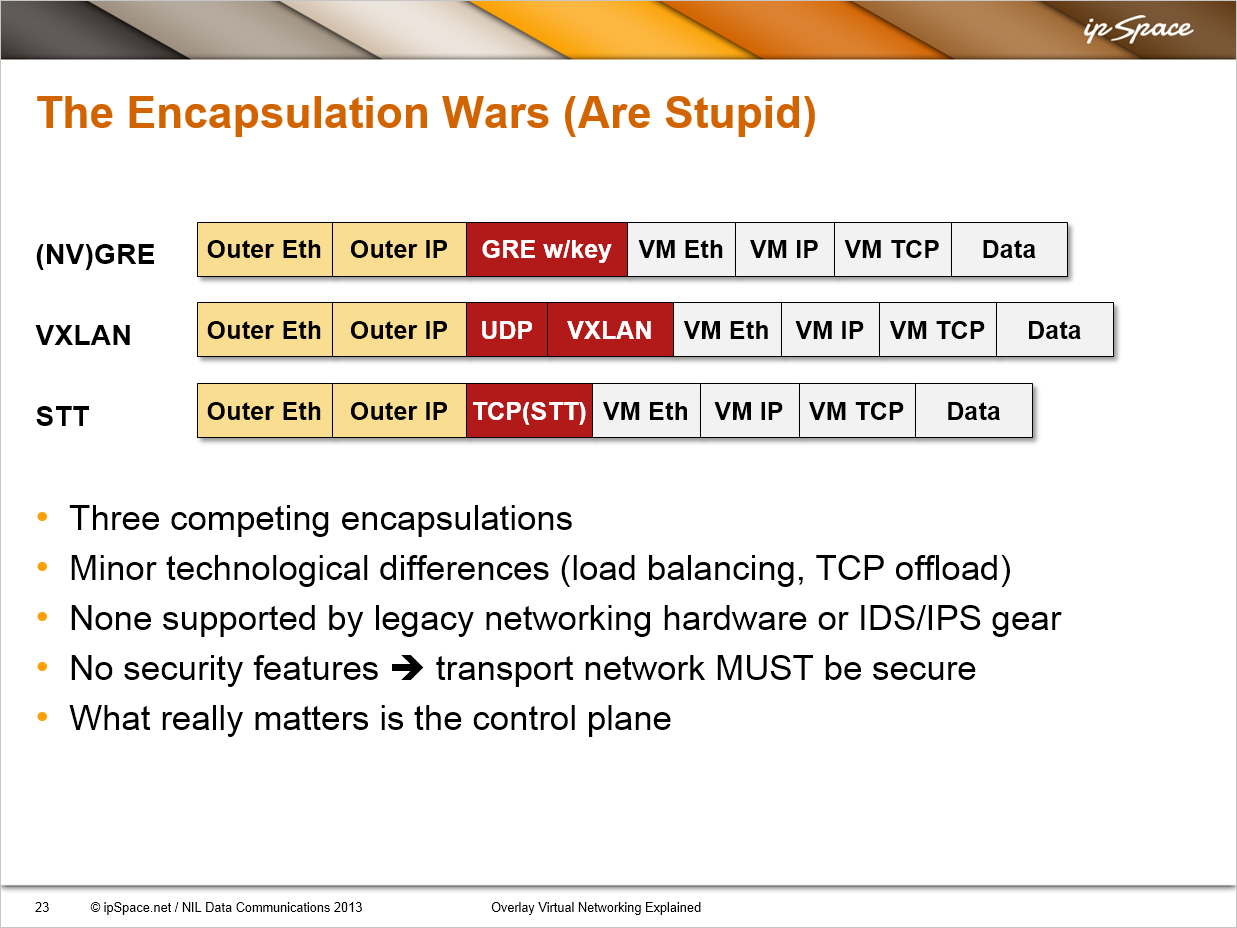
Multiple overlay network encapsulations are nothing more than a major inconvenience (and religious wars based on individual bit fields close to meaningless) for anyone trying to support more than one overlay virtual networking technology (just ask F5 or Arista).
The key differentiator between scalable and not-so-very-scalable architectures and technologies is the control plane – the mechanism that maps (at the very minimum) remote VM MAC address into a transport network IP address of the target hypervisor (see A Day in a Life of an Overlaid Virtual Packet for more details).
… updated on Wednesday, November 18, 2020 15:42 UTC
Management, Control, and Data Planes in Network Devices and Systems
Every single network device (or a distributed system like QFabric) has to perform at least three distinct activities:
- Process the transit traffic (that’s why we buy them) in the data plane;
- Figure out what’s going on around it with the control plane protocols;
- Interact with its owner (or NMS) through the management plane.
Routers are used as a typical example in every text describing the three planes of operation, so let’s stick to this time-honored tradition:
What’s Coming in Hyper-V Network Virtualization (Windows Server 2012 R2)
Right after Microsoft’s TechEd event CJ Williams kindly sent me links to videos describing new features in upcoming Windows Server (and Hyper-V) release. I would strongly recommend you watch What’s New in Windows Server 2012 R2 Networking and Deep Dive on Hyper-V Network Virtualization in Windows Server 2012 R2, and here’s a short(er) summary.
This blog post is describing futures that will ship in 2H2013. However, as all the videos mentioned above included live demos, and the preview release shipped on June 24th, it’s obvious they’re past the “it works so great in PowerPoint” stage.
All it takes is a single misdirected STP packet ...
... and the rest is history ;)

Optimal Layer-3 Forwarding with Active/Active VRRP (Enterasys Fabric Routing)
Enterasys implemented optimal layer-3 forwarding with an interesting trick: they support VRRP like any other switch vendor, but allow you to make all members of a VRRP group active forwarders regardless of their status.
Apart from a slightly more synchronized behavior, their implementation doesn’t differ much from Arista’s Virtual ARP, and thus shares the same design and deployment caveats.
For more information, watch the Fabric Routing video from the Enterasys Robust Data Center Interconnect Solutions webinar.
A Day in a Life of an Overlaid Virtual Packet
I explain the intricacies of overlay network forwarding in every overlay-network-related webinar (Cloud Computing Networking, VXLAN deep dive...), but never wrote a blog post about them. Let’s fix that.
First of all, remember that most mainstream overlay network implementations (Cisco Nexus 1000V, VMware vShield, Microsoft Hyper-V) don’t change the intra-hypervisor network behavior: a virtual machine network interface card (VM NIC) is still connected to a layer-2 hypervisor switch. The magic happens between the internal layer-2 switch and the physical (server) NIC.
Can I Use Shared (RFC 6598) IPv4 Address Space Within My Network?
Andrew sent me the following question: “I'm pushing to start a conversation about IPv6 in my organization, but meanwhile I've no RFC 1918 space left. What's your take on 100.64.0.0/10 - it's seems like this is available for RFC 1918 purposes, even if not intentionally?”
Short answer: Don’t even think about that!
Temper Your MacGyver Streak
Microseconds after VXLAN was launched at VMworld 2011, someone started promoting it as a data center extension solution. Even though layer-2 DCI doesn’t make much sense (even to server people) and VXLAN is really not a DCI solution, the lure of misusing a technology was irresistible.
Dual-Stack Security Exposures
Dual-stack exposures were the last topic Eric Vyncke and myself addressed in the IPv6 security webinar. They range from missing ip6tables on Linux hosts to unintentional split-tunnel VPNs and missing access classes on Cisco IOS devices.