
Worth Reading: Some Thoughts on Digital Twins
I encountered several articles explaining the challenges of simulating your network in a virtual lab in the last few months, including:
- Some thoughts on digital twins by Jeff McLaughlin
- Network Simulation is hard – Part 1, Part 2 – by Pete Crocker
- Twenty-five open-source network emulators and simulators you can use in 2023 by Brian Linkletter
Enjoy!
Worth Reading: Introduction of EVPN at DE-CIX
Numerous Internet Exchange Points (IXP) started using VXLAN years ago to replace tradition layer-2 fabrics with routed networks. Many of them tried to avoid the complexities of EVPN and used VXLAN with statically-configured (and hopefully automated) ingress replication.
A few went a step further and decided to deploy EVPN, primarily to deploy Proxy ARP functionality on EVPN switches and reduce the ARP/ND traffic. Thomas King from DE-CIX described their experience on APNIC blog – well worth reading if you’re interested in layer-2 fabrics.
Video: What Is Software-Defined Data Center
A few years ago, I was asked to deliver a What Is SDDC presentation that later became a webinar. I forgot about that webinar until I received feedback from one of the viewers a week ago:
If you like to learn from the teachers with the “straight to the point” approach and complement the theory with many “real-life” scenarios, then ipSpace.net is the right place for you.
I haven’t realized people still find that webinar useful, so let’s make it viewable without registration, starting with What Problem Are We Trying to Solve and What Is SDDC.
netlab 1.6.2: More Reporting Goodies
netlab release 1.6.2 improved reporting capabilities:
- BGP reports and IP addressing reports are fully IPv6-aware
- Some columns in BGP reports are optional to reduce the width of text reports
- You can filter the reports you’re interested in when using netlab show reports command
- Reports relying on ipaddr Ansible filter display warnings (instead of crashing) if you don’t have Ansible installed.
In other news:
- Stefano Sasso added support for ArubaOS-CX running within containerlab
- You can use inter-VRF route leaking with Cumulus Linux or FRR
BGP Labs: Route Aggregation
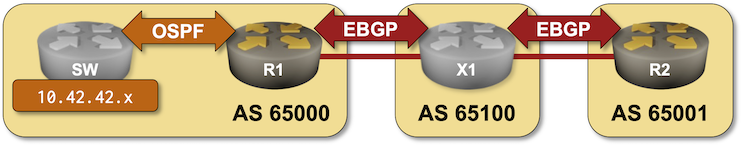
In the BGP Route Aggregation lab you can practice:
- OSPF-to-BGP route redistribution
- BGP route aggregation
- Suppression of more-specific prefixes in the BGP table
- Prefix-based filtering of outbound BGP updates
What Is Ultra Ethernet All About?
If you’re monitoring the industry press (or other usual hype factories), you might have heard about Ultra Ethernet, a dazzling new technology that will be developed by the Ultra Ethernet Consortium1. What is it, and does it matter to you (TL&DR: probably not2)?
As always, let’s start with What Problem Are We Solving?
BGP Session Security: Be Very Skeptical
A while ago I explained how Generalized TTL Security Mechanism could be used to prevent denial-of-service attacks on routers running EBGP. Considering the results published in Analyzing the Security of BGP Message Parsing presentation from DEFCON 31 I started wondering how well GTSM implementations work.
TL&DR summary:
Worth Reading: Flow Distribution Across ECMP Paths
Dip Singh wrote another interesting article describing how ECMP load balancing implementations work behind the scenes. Absolutely worth reading.
Worth Reading: Single-Port LAGs
Lindsay Hill described an excellent idea: all ports on your switches routers should be in link aggregation groups even when you have a single port in a group. That approach allows you to:
- Upgrade the link speed without changing any layer-3 configuration
- Do link maintenance without causing a routing protocol flap
It also proves RFC 1925 rule 6a, but then I guess we’re already used to that ;)
How GitHub Saved My Day
I always tell networking engineers who aspire to be more than VLAN-munging CLI jockeys to get fluent with Git. I should also be telling them that while doing local version control is the right thing to do, you should always have backups (in this case, a remote repository).
I’m eating my own dog food1 – I’m using a half dozen Git repositories in ipSpace.net production2. If they break, my blog stops working, and I cannot publish new documents3.
Now for a fun fact: Git is not transactionally consistent.