
BGP Labs: Use BFD to Speed Up Convergence
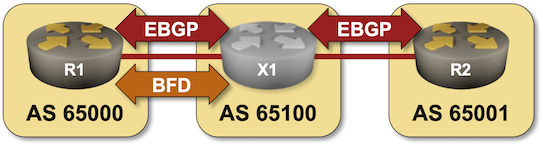
In the next BGP labs exercise, you can practice tweaking BGP timers and using BFD to speed up BGP convergence.
Why Do We Need Source IP Addresses in IP Headers?
After discussing names, addresses and routes, and the various addresses we might need in a networking stack, we’re ready to tackle an interesting comment made by a Twitter user as a reply to my Why Is Source Address Validation Still a Problem? blog post:
Maybe the question we should be asking is why there is a source address in the packet header at all.
Most consumers of network services expect a two-way communication – you send some stuff to another node providing an interesting service, and you usually expect to get some stuff back. So far so good. Now for the fun part: how does the server know where to send the stuff back to? There are two possible answers1:
Does EVPN/VXLAN over SD-WAN Make Sense?
It looks like we might be seeing VXLAN-over-SDWAN deployments in the wild. Here’s the “why that makes sense” argument I received from a participant of the ipSpace.net Design Clinic in which I wasn’t exactly enthusiastic about the idea.
Also, the EVPN-over-WAN idea is not hypothetical since EVPN+VXLAN is now the easiest way to build L3VPN with data center switches that don’t support MPLS LDP. Folks with no interest in EVPN’s L2 features are still using it for L3VPN.
Let’s unravel this scenario a bit:
Repost: L2 Is Bad
Roman Pomazanov documented his thoughts on the beauties of large layer-2 domains in a LinkedIn article and allowed me to repost it on ipSpace.net blog to ensure it doesn’t disappear
First of all: “L2 is a single failure domain”, a problem at one point can easily spread to the entire datacenter.
BGP Labs: Protect EBGP Sessions
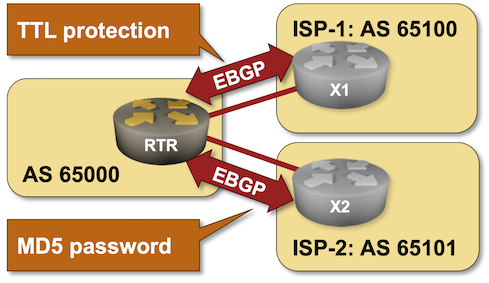
I published another BGP labs exercise a few days ago. You can use it to practice EBGP session protection, including Generalized TTL Security Mechanism (GTSM) and TCP MD5 checksums1.
-
I would love to add TCP-AO to the mix, but it’s not yet supported by the Linux kernel, and so cannot be used in Cumulus Linux or FRR containers. ↩︎
Addresses in a Networking Stack
After discussing names, addresses and routes, it’s time for the next question: what kinds of addresses do we need to make things work?
End-users (clients) are usually interested in a single thing: they want to reach the service they want to use. They don’t care about nodes, links, or anything else.
End-users might want to use friendly service names, but we already know we need addresses to make things work. We need application level service identifiers – something that identifies the services that the clients want to reach.
Names, Addresses, and Routes
It always helps to figure out the challenges of a problem you’re planning to solve, and to have a well-defined terminology. This blog post will mention a few challenges we might encounter while addressing various layers of the networking stack, from data-link layer and all the way up to the application layer, and introduce the concepts of names, addresses and routes.
According to Martin Fowler, one of the best quotes I found on the topic originally came from Phil Karlton:
Dataplane MAC Learning with EVPN
Johannes Resch submitted the following comment to the Is Dynamic MAC Learning Better Than EVPN? blog post:
I’ve also recently noticed some vendors claiming that dataplane MAC learning is so much better because it reduces the number of BGP updates in large scale SP EVPN deployments. Apparently, some of them are working on IETF drafts to bring dataplane MAC learning “back” to EVPN. Not sure if this is really a relevant point - we know that BGP scales nicely, and its relatively easy to deploy virtualized RR with sufficient VPU resources.
While he’s absolutely correct that BGP scales nicely, the questions to ask is “what is the optimal way to deliver a Carrier Ethernet service?”
Worth Reading: Where Are the Self-Driving Cars?
Gary Marcus wrote an interesting essay describing the failure of self-driving cars to face the unknown unknowns. The following gem from his conclusions applies to AI in general:
In a different world, less driven by money, and more by a desire to build AI that we could trust, we might pause and ask a very specific question: have we discovered the right technology to address edge cases that pervade our messy really world? And if we haven’t, shouldn’t we stop hammering a square peg into a round hole, and shift our focus towards developing new methodologies for coping with the endless array of edge cases?
BGP Labs: Bidirectional Route Redistribution
In the next BGP labs exercise, you’ll build the customer part of an MPLS/VPN solution. You’ll use bidirectional OSPF-to-BGP route redistribution to connect two sites running OSPF over a Service Provider MPLS backbone.
