
Pleasant Surprise: Google AI Overview
When I was writing a blog post, I needed a link to the netlab lab topology documentation, so I searched for “netlab lab topology” (I know I’m lazy, but it felt quicker than navigating the sidebar menu).
The AI overview I got was way too verbose, but it nailed the Key Concepts and How It Works well enough that I could just use them in the netlab README.md file. Maybe this AI thing is becoming useful after all ;)
Use Additional BGP Paths for IBGP Load Balancing
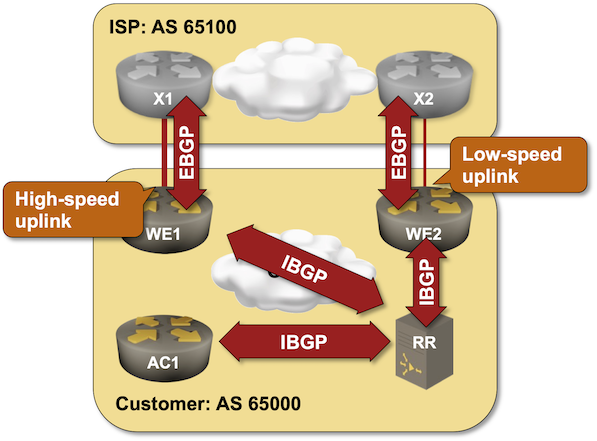
I wrote about the optimal BGP path selection with BGP additional paths in 2021, and I probably mentioned (in one of the 360 BGP-related blog posts) that you need it to implement IBGP load balancing in networks using BGP route reflectors. If you want to try that out, check out the IBGP Load Balancing with BGP Additional Paths lab exercise.
Click here to start the lab in your browser using GitHub Codespaces (or set up your own lab infrastructure). After starting the lab environment, change the directory to lb/4-ibgp-add-path and execute netlab up.
Arista EOS Hates a Routing Instance with No Interfaces
I always ask engineers reporting a netlab bug to provide a minimal lab topology that would reproduce the error, sometimes resulting in “interesting” side effects. For example, I was trying to debug a BGP-related Arista EOS issue using a netlab topology similar to this one:
defaults.device: eos
module: [ bgp ]
nodes:
  a: { bgp.as: 65000 }
  b: { bgp.as: 65001 }
Imagine my astonishment when the two switches failed to configure BGP. Here’s the error message I got when running the netlab’s deploy device configurations Ansible playbook:
SwiNOG 40: When a Routing Control Functions Is Too Fresh
During integration testing, I find unexpected quirks in network devices way too often. However, that’s infinitely better than experiencing them in production (even after thoroughly testing stuff) while discovering that your peers don’t care about routing security, RPKI, and similar useless stuff.
For example, what happens if you define a new Routing Control Function (RFC) on Arista EOS and apply it to BGP routing updates in the same configuration session? You’ll find out in the Sorry We Messed Up (video) presentation Stefan Funke had at SwiNOG 40 (note: the bug has been fixed in the meantime).
Updated: netlab Network Topology Graphs
netlab release 25.09 introduced numerous graphing enhancements and a new graph type (IS-IS graphs), so I decided to write a series of blog posts explaining how you can generate graphs from netlab lab topologies.
I wrote an intro to netlab topology graphs years ago, and as expected, it was hopelessly outdated, so I started the project with a complete overhaul of that article.
[FATAL] Ansible Release 12.0 Breaks netlab Jinja2 Templates
On September 9th, the ansible release 12.0 appeared on PyPi. It requires ansible-core release 2.19, which includes breaking changes to Jinja2 templating. netlab Jinja2 templates rely on a few Ansible Jinja2 filters; netlab thus imports and uses those filters, and it looks like those imports pulled in the breaking changes that consequently broke the netlab containerlab configuration file template (details).
netlab did not check the Ansible core version (we never had a similar problem in the past), and the installation scripts did not pin the Ansible version (feel free to blame me for this one), which means that any new netlab installation created after September 9th crashed miserably on the simplest lab topologies.
This is the workaround we implemented in netlab release 25.09-post1 (released earlier today):
Lab: Running IS-IS over IPv4 Unnumbered and IPv6 LLA Interfaces
IS-IS does not use IPv4 or IPv6, so it should be a no-brainer to run it over IPv4 unnumbered or IPv6 LLA interfaces. The latter is true; the former is smack in the middle of the It Depends™ territory.
Want to know more or test the devices you’re usually working with? The Running IS-IS Over Unnumbered/LLA-only Interfaces lab exercise is just what you need.

Click here to start the lab in your browser using GitHub Codespaces (or set up your own lab infrastructure). After starting the lab environment, change the directory to basic/7-unnumbered and execute netlab up.
The Curious Case of 'ip host' Configuration Command
Since time immemorial, I have used the ip host router configuration command to get host-to-IP mappings in networking labs without going through the hassle of setting up a DNS server. Some devices even accepted multiple IP addresses in the ip host command, allowing you to list all router interfaces in a single command and get reverse (IP-to-host) mapping working like a charm. Or so I thought 🤦♂️
It turns out I’m too old, and what I know is sometimes no longer true. It seems that the last implementation working as I expected is Cisco IOS Classic ☹️
Labbing Network Technology Details with netlab
It’s been over four years since I published the last Software Gone Wild episode. In the meantime, I spent most of my time developing an open-source labbing tool, so it should be no surprise that the first post-hiatus episode focused on a netlab use case: how Ethan Banks (of the PacketPushers fame) is using the tool to quickly check the technology details for his N is for Networking podcast.
As expected, our discussion took us all over the place, including (according to Riverside AI):
SwiNOG 40: Reliability of High-Speed Transceivers
Whenever you see Gerhard Stein and Thomas Weible from Flexoptix in a list of presenters, three things immediately become obvious:
- It will be about transceivers
- It will be fun
- It will include some crazy stuff
Their SwiNOG 40 presentation (video) met all three expectation. We learned how well transceivers cope with high temperatures and what happens when you try to melt them with a heat gun.