
Video: Kubernetes Architecture
Yesterday I mentioned the giant glob of complexity called Kubernetes (see also more nuanced take on the topic). If you want to slowly unravel it, Kubernetes Architecture video from the excellent Kubernetes Networking Deep Dive webinar by Stuart Charlton is a pretty good starting point.
MTU Settings in Virtual Network Devices
When I finally1 managed to get SR Linux running with netlab, I wanted to test how it interacts with Cumulus VX and FRR in an OSPF+BGP lab… and failed. Jeroen Van Bemmel quickly identified the culprit: MTU. Yeah, it’s always the MTU (or DNS, or BGP).
I never experienced a similar problem, so of course I had to identify the root cause:
Three Dimensions of BGP Address Family Nerd Knobs
Got into an interesting BGP discussion a few days ago, resulting in a wild chase through recent SRv6 and BGP drafts and RFCs. You might find the results mildly interesting ;)
BGP has three dimensions of address family configurability:
- Transport sessions. Most vendors implement BGP over TCP over IPv4 and IPv6. I’m sure there’s someone out there running BGP over CLNS1, and there are already drafts proposing running BGP over QUIC2.
- Address families enabled on individual transport sessions, more precisely a combination of Address Family Identifier (AFI) and Subsequent Address Family Identifier.
- Next hops address family for enabled address families.
More: Hardware Differences between Routers and Switches
Aaron Glenn sent me his thoughts on hardware differences between routers and switches based on the last paragraph of Dmytro Shypovalov’s views on the topic
To conclude, what is the difference between routers and switches in my opinion? I have absolutely no idea.
Sample Lab: RSVP TE on Junos
It’s amazing how creative networking engineers become once they have the basic tools to get the job done a bit quicker. Last week Pete Crocker published the largest topology I’ve seen built with netlab so far: a 13-router lab running RSVP TE to transport IP traffic between external autonomous systems1.
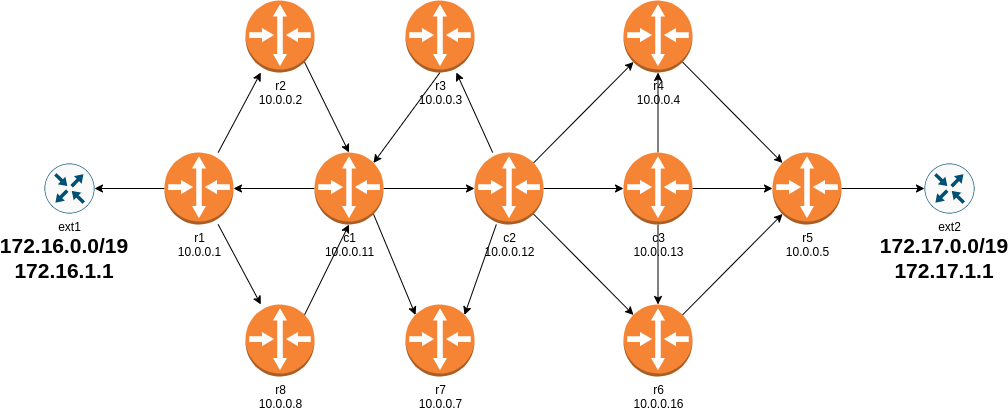
Lab topology
Video: Machine Learning Techniques
After Javier Antich walked us through the AI/ML hype and described the basics of machine learning it was time for a more thorough look at:
- Machine learning techniques, including unsupervised learning (clustering and anomaly detection), supervised learning (regression, classification and generation) and reinforced learning
- Machine learning implementations, including neural networks, deep neural networks and convolutional neural networks.
Introducing netlab Plugins
Remember the BGP anycast lab I described in December 2021? In that blog post I briefly mentioned a problem of extraneous IBGP sessions and promised to address it at a later date. Let’s see how we can fix that with a netlab plugin.
We always knew that it’s impossible to implement every nerd knob someone would like to have when building their labs, and extending the tool with Python plugins seemed like the only sane way to go. We added custom plugins to netlab in late 2021, but I didn’t want to write about them because we had to optimize the internal data structures first.
Layer-3 Carrier Ethernet
One of ipSpace.net subscribers asked for my opinion about Adaptive IP, a concept promoted by one of the optical connectivity vendors. As he put it:
My interest in Carrier Ethernet moving up to Layer 3 is to see if it would be something to account for in the future.
A quick search resulted in a marketecture using Segment Routing (of course) and an SDN controller (what else could one be using today) using Path Computation Element Protocol (PCEP) to program the network devices… and then I hit a regwall. They wanted to collect my personal details to grace me with their whitepaper, and I couldn’t find even a link to the product documentation.
Running IS-IS over Unnumbered Ethernet Interfaces
Last time we figured out that we cannot run OSPF over unnumbered interfaces that are not point-to-point links because OSPF makes assumptions about interface IP addresses. IS-IS makes no such assumptions; IPv4 and IPv6 prefixes are just a bunch of TLVs exchanged between routers over a dedicated layer-3 protocol with ridiculously long network addresses.
Could we thus build a totally unnumbered IP network with IS-IS even when the network contains multi-access segments? It depends:
Video: Local Area Network Addressing
In the Local Area Network Addressing video (part of How Networks Really Work webinar) I covered numerous obscure LAN addressing details including:
- There’s no layer-2 address in Fibre Channel frames (because FC is routing not bridging);
- Why is the multicast bit the lowest bit (0x01) in the first byte on Ethernet but the highest bit (0x80) on Token Ring or FDDI;
- How some NIC manufacturers never got the memo on what OUI really means.