
Arista cEOS Does Not Apply ACLs to Control-Plane Traffic
When someone starts singing the Use Digital Twins to Test Your Network hymn (or, more recently, tells you how AI agents can do that to validate their ideas), ask them about these minor details. If they persist, point them (not that it would help) to this long list of gotchas.
That list just got longer: Arista cEOS container does not apply inbound ACLs to control-plane traffic (Arista vEOS VM does).
When testing the BGP FSM implementations, I tried using ACLs to get one-way connectivity on Arista cEOS containers. It didn’t work; EBGP sessions were established regardless of what I put in the ACL. I shelved that weird behavior at that time; when I decided to investigate it weeks later, I started with the simplest possible scenario:
- Two hosts (H1, H2) are connected to an Arista cEOS container (SW)
- The cEOS container has an ACL that blocks ICMP and permits everything else
- The ACL is applied in the inbound direction to all switch ports
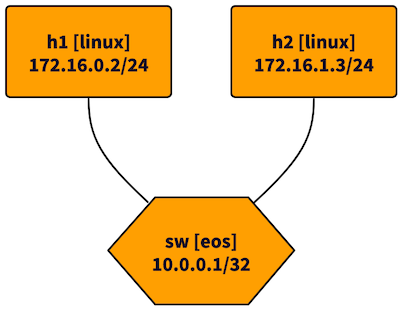
Lab scenario
Here’s the relevant Arista cEOS configuration:
interface Ethernet1
   description sw -> h1 [stub]
   platform tfa phy control-frame disabled
   no switchport
   ip address 172.16.0.1/24
   ip access-group noicmp_ipv4 in
!
interface Ethernet2
   description sw -> h2 [stub]
   platform tfa phy control-frame disabled
   no switchport
   ip address 172.16.1.1/24
   ip access-group noicmp_ipv4 in
!
ip access-list noicmp_ipv4
   100 deny icmp any any
   110 permit ip any any
Guess what: H1 can’t ping H2 (as expected), but it can ping the IP addresses of SW:
h1:/# ping h2
PING h2 (172.16.1.3): 56 data bytes
^C
--- h2 ping statistics ---
5 packets transmitted, 0 packets received, 100% packet loss
h1:/# ping sw
PING sw (10.0.0.1): 56 data bytes
64 bytes from 10.0.0.1: seq=0 ttl=64 time=0.059 ms
64 bytes from 10.0.0.1: seq=1 ttl=64 time=0.097 ms
^C
--- sw ping statistics ---
2 packets transmitted, 2 packets received, 0% packet loss
round-trip min/avg/max = 0.059/0.078/0.097 ms
h1:/# ping Ethernet1.sw
PING Ethernet1.sw (172.16.0.1): 56 data bytes
64 bytes from 172.16.0.1: seq=0 ttl=64 time=0.059 ms
64 bytes from 172.16.0.1: seq=1 ttl=64 time=0.074 ms
^C
--- Ethernet1.sw ping statistics ---
2 packets transmitted, 2 packets received, 0% packet loss
round-trip min/avg/max = 0.059/0.066/0.074 ms
h1:/# ping Ethernet2.sw
PING Ethernet2.sw (172.16.1.1): 56 data bytes
64 bytes from 172.16.1.1: seq=0 ttl=64 time=0.067 ms
64 bytes from 172.16.1.1: seq=1 ttl=64 time=0.060 ms
^C
--- Ethernet2.sw ping statistics ---
2 packets transmitted, 2 packets received, 0% packet loss
round-trip min/avg/max = 0.060/0.063/0.067 ms
QED: Arista cEOS release 4.35.2F does not apply ACLs to traffic sent to its own IP addresses1.
Interestingly, Arista vEOS (the virtual machine) works as expected: the inbound ACL blocks all ICMP, and it’s inserted early enough in the packet forwarding process that you cannot see the incoming ICMP packets with tcpdump running on the switch.
Reproducing the Results
Here’s the netlab topology I used in the test (you’ll need the release 26.08 with ACL support to try it out). Change the provider to libvirt to test the Arista vEOS VM.
provider: clab

module: [ routing ]

nodes:
  sw:
    device: eos
    routing.acl.noicmp:
    - action: deny
      protocol: icmp
    - protocol: ip
  h1.device: linux
  h2.device: linux

links:
- h1:
  sw.routing.acl.in: noicmp
- h2:
  sw.routing.acl.in: noicmp
-
But then, who would ever want to test that in a digital twin, right? 🤪 ↩︎