
Category: VXLAN
DHCP Relaying in VXLAN Segments
After I got the testing infrastructure in place (simple DHCP relay, VRF-aware DHCP relay), I was ready for the real fun: DHCP relaying in VXLAN (and later EVPN) segments.
TL&DR: It works exactly as expected. Even though I had anycast gateway configured on the VLAN, the Arista vEOS switches used their unicast IP addresses in the DHCP relaying process. The DHCP server had absolutely no problem dealing with multiple copies of the same DHCP broadcast relayed by different switches attached to the same VLAN. One could only wish things were always as easy in the networking land.
Why Would You Need an Overlay Network?
I got this question from one of ipSpace.net subscribers:
My VP is not a fan of overlays and is determined to move away from our legacy implementation of OTV, VXLAN, and EVPN1. We own and manage our optical network across all sites; however, it’s hard for me to picture a network design without overlays. He keeps asking why we need overlays when we own the optical network.
There are several reasons (apart from RFC 1925 Rule 6a) why you might want to add another layer of abstraction (that’s what overlay networks are in a nutshell) to your network.
netlab: VRF Lite over VXLAN Transport
One of the comments I received after publishing the Use VRFs for VXLAN-Enabled VLANs claimed that:
I’m firmly of the belief that VXLAN should be solely an access layer/edge technology and if you are running your routing protocols within the tunnel, you’ve already lost the plot.
That’s a pretty good guideline for typical data center fabric deployments, but VXLAN is just a tool that allows you to build multi-access Ethernet networks on top of IP infrastructure. You can use it to emulate E-LAN service or to build networks similar to what you can get with DMVPN (without any built-in security). Today we’ll use it to build a VRF Lite topology with two tenants (red and blue).
netlab VXLAN Router-on-a-Stick Example
In October 2022 I described how you could build a VLAN router-on-a-stick topology with netlab. With the new features added in netlab release 1.41 we can do the same for VXLAN-enabled VLANs – we’ll build a lab where a router-on-a-stick will do VXLAN-to-VXLAN routing.
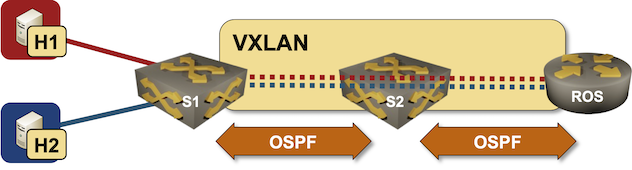
Lab topology
… updated on Thursday, November 10, 2022 07:58 UTC
Using EVPN/VXLAN with MLAG Clusters
There’s no better way to start this blog post than with a widespread myth: we don’t need MLAG now that most vendors have implemented EVPN multihoming.
TL&DR: This myth is close to the not even wrong category.
As we discussed in the MLAG System Overview blog post, every MLAG implementation needs at least three functional components:
Use VRFs for VXLAN-Enabled VLANs
I started one of my VXLAN tests with a simple setup – two switches connecting two hosts over a VXLAN-enabled (gray tunnel) red VLAN. The switches are connected with a single blue link.
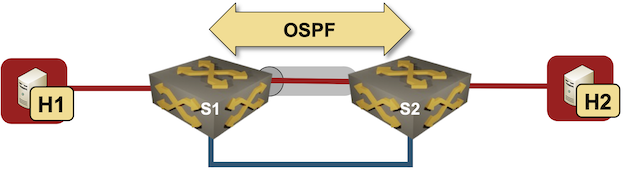
Test lab
I configured VLANs and VXLANs, and started OSPF on S1 and S2 to get connectivity between their loopback interfaces. Here’s the configuration of one of the Arista cEOS switches:
Worth Reading: VXLAN Drops Large Packets
Ian Nightingale published an interesting story of connectivity problems he had in a VXLAN-based campus network. TL&DR: it’s always the MTU (unless it’s DNS or BGP).
The really fun part: even though large L2 segments might have magical properties (according to vendor fluff), there’s no host-to-network communication in transparent bridging, so there’s absolutely no way that the ingress VTEP could tell the host that the packet is too big. In a layer-3 network you have at least a fighting chance…
netlab EVPN/VXLAN Bridging Example
netlab release 1.3 introduced support for VXLAN transport with static ingress replication and EVPN control plane. Last week we replaced a VLAN trunk with VXLAN transport, now we’ll replace static ingress replication with EVPN control plane.
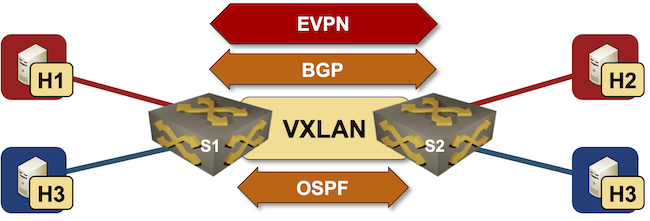
Lab topology
Worth Reading: EVPN/VXLAN with FRR on Linux Hosts
Jeroen Van Bemmel created another interesting netlab topology: EVPN/VXLAN between SR Linux fabric and FRR on Linux hosts based on his work implementing VRFs, VXLAN, and EVPN on FRR in netlab release 1.3.1.
Bonus point: he also described how to do multi-vendor interoperability testing with netlab.
If only he wouldn’t be publishing his articles on a platform that’s almost as user-data-craving as Google.
… updated on Wednesday, September 28, 2022 17:22 UTC
Combining MLAG Clusters with VXLAN Fabric
In the previous MLAG Deep Dive blog posts, we discussed the innards of a standalone MLAG cluster. Now let’s see what happens when we connect such a cluster to a VXLAN fabric – we’ll use our standard MLAG topology and add a VXLAN transport underlay to it with another switch connected to the other end of the underlay network.
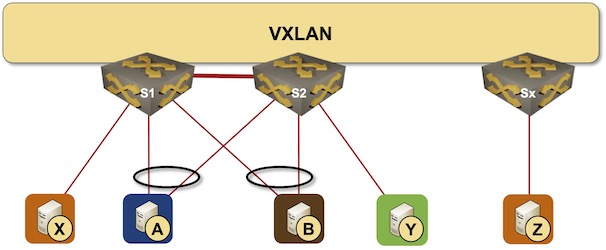
MLAG cluster connected to a VXLAN fabric