
Category: IPv6
IPv6 Trilogy
Similar to Data Center and DMVPN trilogy, I bundled the core IPv6 webinars into IPv6 trilogy. Following the great example set by Douglas Adams, the trilogy has four webinars (the real reason: it’s not likely someone would need both Enterprise and Service Provider introductory webinar).
IPv6 RADIUS Accounting
Somehow I got involved in an IPv6 RADIUS accounting discussion. This is what I found to work in Cisco IOS release 15.2(4)S:
The Best of Last Week’s IPv6 Summit
Last week’s IPv6 summit organized by Jan Žorž was probably one of the best events to attend for engineers interested in real-life IPv6 deployment experience. Some of the highlights included:
- IPv6: Past, Present and Future by Robert Hinden, one of the creators of IPv6;
- Cisco’s IPv6 deployment experiences by Andrew Yourtchenko, technical leader @ Cisco;
- IPv6 deployment in Yahoo by Jason Fesler, distinguished architect @ Yahoo;
- Lessons learned while deploying IPv6 in US Government by Ron Broersma, Network Security Manager @ SPAWAR;
- IPv6 implementation in Time Warner Cable by their director of technology development: Lee Howard of the CGN-is-too-expensive fame.
Enjoy! ... and thank you, Jan, for an excellent event.
Skip the Transitions, Build IPv6-Only Data Centers
During last week’s IPv6 Summit I presented an interesting idea first proposed by Tore Anderson: let’s skip all the transition steps and implement IPv6-only data centers.
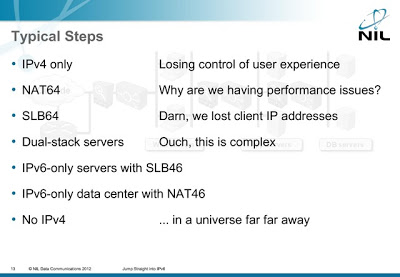
You can view the presentation or watch the video; for more details (including the description of routing tricks to get this idea working with vanilla NAT64), watch Tore’s RIPE64 presentation.
IPv6 First-Hop Security: Ideal OpenFlow Use Case
Supposedly it’s a good idea to be able to identify which one of your users had a particular IP address at the time when that source IP address created significant havoc. We have a definitive solution for the IPv4 world: DHCP server logs combined with DHCP snooping, IP source guard and dynamic ARP inspection. IPv6 world is a mess: read this e-mail message from v6ops mailing list and watch Eric Vyncke’s RIPE65 presentation for excruciating details.
Don’t use IPv6 RA on server LANs
Enabling IPv6 on a server LAN with the ipv6 address interface configuration without taking additional precautions might be a bad idea. All modern operating systems have IPv6 enabled by default, and the moment someone starts sending Router Advertisement (RA) messages, they’ll auto-configure their LAN interfaces.
You MUST Take Control of IPv6 in Your Network
I’m positive most of you are way too busy dealing with operational issues to start thinking about IPv6 deployment (particularly if you’re working in the enterprise world; European service providers using the same “strategy” just got a rude wake-up call). Bad idea – if you ignore IPv6, it will eventually blow up in your face. Here’s how:
The best of RIPE65
Last week I had the privilege of attending RIPE65, meeting a bunch of extremely bright SP engineers, and listening to a few fantastic presentations (full meeting report @ RIPE65 web site).
I knew Geoff Huston would have a great presentation, but his QoS presentation was even better than I expected. I don’t necessarily agree with everything he said, but every vendor peddling QoS should be forced to listen to his explanation of the underlying problems and kludgy solutions first.
IPv6 over PPPoE works great with IOS XE 3.7
Beatrice Ghorra (@beebux) was kind enough to share the results of her IPv6-over-PPPoE tests with me.
Short summary: everything works as expected on ASR 1K running IOS XE 3.7.
Do You Need IPsec to Run IPv6?
The usual claim that “IPv6 has better security because it includes mandatory IPsec support” is evidently creating some confusion, at least based on a set of questions I received from one of my readers.
Can IPv6 work without IPsec?
Absolutely. Most IPv6 deployments don’t use IPsec (unless you’re building IPsec-based VPNs over IPv6 transport infrastructure).