Category: Data Center
What is OpenFlow?
A typical networking device (bridge, router, switch, LSR …) has control and data plane. The control plane runs all the control protocols (including port aggregation, STP, TRILL, MAC address learning and routing protocols) and downloads the forwarding instructions into the data plane structures, which can be simple lookup tables or specialized hardware (hash tables or TCAMs).
Brocade VCS fabric has almost-perfect load balancing
Short summary for differently-attentive: proprietary load balancing Brocade uses over ISL trunks in VCS fabric is almost perfect (and way better for high-throughput sessions than what you get with other link aggregation methods).
During the Data Center Fabrics Packet Pushers Podcast we’ve been discussing load balancing across aggregated inter-switch links and Brocade’s claims that its “chip-based balancing” performs better than standard link aggregation group (LAG) load balancing. Ever skeptical, I said all LAG load balancing is chip-based (every vendor does high-speed switching in hardware). I also added that I would be mightily impressed if they’d actually solved intra-flow packet scheduling.
Published on , commented on July 6, 2022
Open Networking Foundation – Fabric Craziness Reaches New Heights
Some of the biggest buyers of the networking gear have decided to squeeze some extra discount out of the networking vendors and threatened them with open-source alternative, hoping to repeat the Linux/Apache/MySQL/PHP saga that made it possible to build server farms out of low-cost commodity gear with almost zero licensing costs. They formed the Open Networking Foundation, found a convenient technology (OpenFlow) and launched another major entrant in the Buzzword Bingo – Software-Defined Networking (SDN).
Networking vendors, either trying to protect their margins by stalling the progress of this initiative, or stampeding into another Wild West Gold Rush (hoping to unseat their bigger competitors with low-cost standard-based alternatives) have joined the foundation in hordes; the list of initial members (see the press release for details) reads like Who’s Who in Networking.
TRILL/Fabric Path – STP Integration
Every Data Center fabric technology has to integrate seamlessly with legacy equipment running the venerable Spanning Tree Protocol (STP) or one of its facelifted incarnations (for example, RSTP or MST). The alternative, called rip-and-replace when talking about other vendors’ boxes or synchronized upgrade when promoting your wares (no, I haven’t heard it yet, but I’m sure it’s coming), is simply indigestible to most data center architects.
TRILL and Cisco’s proprietary Fabric Path take a very definitive stance: the new fabric is the backbone of the network routing TRILL-encapsulated layer-2 frames across bridged segments (TRILL) or contiguous backbone (Fabric Path). Both architectures segment the original STP domain into small chunks at the edges of the network as shown in the following figure:
Does Bridge Assurance Make UDLD Obsolete?
I got an interesting question from Andrew:
Would you say that bridge assurance makes UDLD unnecessary? It doesn't seem clear from any resource I've found so far (either on Cisco's docs or on Google)."
It’s important to remember that UDLD works on physical links whereas bridge assurance works on top of STP (which also implies it works above link aggregation/port channel mechanisms). UDLD can detect individual link failure (even when the link is part a LAG); bridge assurance can detect unaggregated link failures, total LAG failure, misconfigured remote port or a malfunctioning switch.
Don’t lie about proprietary protocols
A few months ago Brocade launched its own version of Data Center Fabric (VCS) and the VDX series of switches claiming that:
The Ethernet Fabric is an advanced multi-path network utilizing an emerging standard called Transparent Interconnection of Lots of Links (TRILL).
Those familiar with TRILL were immediately suspicious as some of the Brocade’s materials mentioned TRILL in the same sentence as FSPF, but we could not go beyond speculations. The Brocade’s Network OS Administrator’s Guide (Supporting Network OS v2.0, December 2010) shows a clear picture.
The Data Center Fabric architectures
Have you noticed how quickly fabric got as meaningless as switching and cloud? Everyone is selling you data center fabric and no two vendors have something remotely similar in mind. You know it’s always more fun to look beyond white papers and marketectures and figure out what’s really going on behind the scenes (warning: you might be as disappointed as Dorothy was). I was able to identify three major architectures (at least two of them claiming to be omnipotent fabrics).
Business as usual
Each networking device (let’s confuse everyone and call them switches) works independently and remains a separate management and configuration entity. This approach has been used for decades in building the global Internet and thus has proven scalability. It also has well-known drawbacks (large number of managed devices) and usually requires thorough design to scale well.
Traffic Trombone (what it is and how you get them)
Every so often I get a question “what exactly is a traffic trombone/tromboning”. Here’s my attempt at a semi-formal definition.
Traffic trombone is a term (probably invented by Greg Ferro) that colorfully describes inter-VLAN traffic flows in a network with stretched (usually overlapping) L2 domains.
In a traditional L2/L3 data center architecture with small L2 domains in the access layer and L3 forwarding across the core network, the inter-subnet traffic flows were close to optimal: a host would send a packet toward the first-hop (ingress) router (across a bridged L2 subnet), the ingress router would forward the packet across an optimal path toward the egress router, and the egress router would deliver the packet (yet again, across a bridged L2 subnet) to the destination host.
What exactly makes something “mission critical”?
Pete Welcher wrote an excellent Data Center L2 Interconnect and Failover article with a great analogy: he compares layer-2 data center interconnect to beer (one might be a good thing, but it rarely stops there). He also raised an extremely good point: while it makes sense to promote load balancers and scale-out architectures, many existing applications will never run on more than a single server (sometimes using embedded database like SQL Express).
L2 DCI with MLAG over VPLS transport?
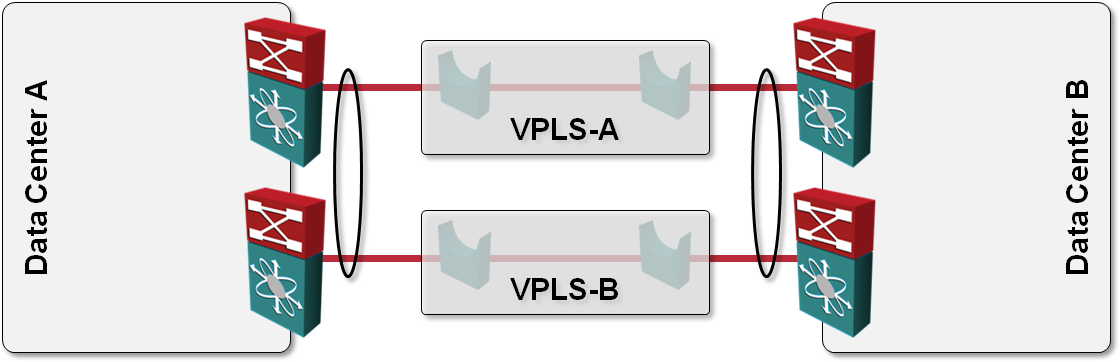
One of the answers I got to my “How would you use VPLS transport in L2 DCI” question was also “Can’t you just order two VPLS services, use them as P2P links and bundle the two links into a multi-chassis link aggregation group (MLAG)?” like this: