Category: Data Center
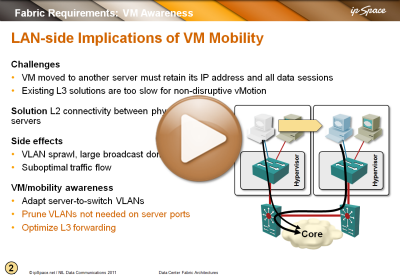
Video: Networking requirements for VM mobility
You’re probably sick and tired of me writing and talking about networking requirements for VM mobility (large VLAN segments that some people want to extend across the globe), but just in case you have to show someone a brief summary, here’s a video taken from the Data Center Fabric Architectures webinar.
You’ll also find VM mobility challenges described to various degrees in Introduction to Virtual Networking, VMware Networking Deep Dive and Data Center Interconnects webinars
… updated on Friday, December 25, 2020 18:17 UTC
Scalable, Virtualized, Automated Data Center
Matt Stone sent me a great set of questions about the emerging Data Center technologies (the headline is also his, not mine) together with an interesting observation “it seems as though there is a lot of reinventing the wheel going on”. Sure is – read Doug Gourlay’s OpenFlow article for a skeptical insider view. Here's a lovely tidbit:
So every few years the networking industry invents some new term whose primary purpose is to galvanize the thinking of IT purchasers, give them a new rallying cry to generate budget, hopefully drive some refresh of the installed base so us vendor folks can make our quarter bookings targets.
But I’m digressing, let’s focus on Matt’s questions. Here are the first few.
MPLS/VPN in the Data Center? Maybe not in the hypervisors
A while ago I wrote that the hypervisor vendors should consider turning the virtual switches into PE-routers. We all know that’s never going to happen due to religious objections from everyone who thinks VLANs are the greatest thing ever invented and MP-BGP is pure evil, but there are at least two good technical reasons why putting MPLS/VPN (as we know it today) in the hypervisors might not be the best idea in very large data centers.
Do we really need Stateless Transport Tunneling (STT)
The first question everyone asked after Nicira had published yet another MAC-over-IP tunneling draft was probably “do we really need yet another encapsulation scheme? Aren’t VXLAN or NVGRE enough?” Bruce Davie tried to answer that question in his blog post (and provided more details in another one), and I’ll try to make the answer a bit more graphical.
VXLAN and EVB questions
Wim (@fracske) De Smet sent me a whole set of very good VXLAN- and EVB-related questions that might be relevant to a wider audience.
If I understand you correctly, you think that VXLAN will win over EVB?
I wouldn’t say they are competing directly from the technology perspective. There are two ways you can design your virtual networks: (a) smart core with simple edge (see also: voice and Frame Relay switches) or (b) smart edge with simple core (see also: Internet). EVB makes option (a) more viable, VXLAN is an early attempt at implementing option (b).
OpenFlow: A perfect tool to build SMB data center
When I was writing about the NEC+IBM OpenFlow trials, I figured out a perfect use case for OpenFlow-controlled network forwarding: SMB data centers that need less than a few hundred physical servers – be it bare-metal servers or hypervisor hosts (hat tip to Brad Hedlund for nudging me in the right direction a while ago)
Does CCIE still make sense?
A reader of my blog sent me this question:
I am a Telecommunication Engineer currently preparing for the CCIE exam. Do you think that in a near future it will be worth to be a CCIE, due to the recent developments like Nicira? What will be the future of Cisco IOS, and protocols like OSPF or BGP? I am totally disoriented about my career.
Well, although I wholeheartedly agree with recent post from Derick Winkworth, the sky is not falling (yet):
Edge Virtual Bridging (802.1Qbg) – a Technology Refusing to Die
I thought Edge Virtual Bridging (EVB) would be the technology transforming the kludgy vendor-specific VM-aware networking solutions into a properly designed architecture, but the launch of L2-over-IP solutions for VMware and Xen hypervisors is making EVB obsolete before it ever made it through the IEEE doors.
Updated Webinar Roadmaps
I finally found just the right set of tools to draw and update webinar roadmaps without too much hassle, and updated all of them to include the webinars developed during late 2011 and planned for 2012:
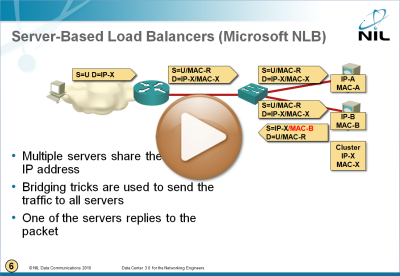
Microsoft Network Load Balancing Behind the Scenes
I figured out I wrote a lot about Microsoft Network Load Balancing (NLB) without ever explaining how that marvel of engineering works. To fix that omission, here’s a short video taken from the Data Center 3.0 webinar.