Category: Cloud
What’s Coming in Hyper-V Network Virtualization (Windows Server 2012 R2)
Right after Microsoft’s TechEd event CJ Williams kindly sent me links to videos describing new features in upcoming Windows Server (and Hyper-V) release. I would strongly recommend you watch What’s New in Windows Server 2012 R2 Networking and Deep Dive on Hyper-V Network Virtualization in Windows Server 2012 R2, and here’s a short(er) summary.
This blog post is describing futures that will ship in 2H2013. However, as all the videos mentioned above included live demos, and the preview release shipped on June 24th, it’s obvious they’re past the “it works so great in PowerPoint” stage.
Smart Fabrics Versus Overlay Virtual Networks
With the recent plethora of overlay networking startups and Cisco Live Dynamic Fabric Architecture announcements it’s time to revisit a blog post I wrote a bit more than a year ago, comparing virtual networks and voice technologies.
They say a picture is worth a thousand words – here are a few slides from my Interop 2013 Overlay Virtual Networking Explained presentation.
ProgrammableFlow Typical Use Cases
The last part of the ProgrammableFlow webinar described typical use cases including Cloud-as-an-Appliance, traffic steering (used by appliances like Radware DefenseFlow) and hypervisor switching with PF1000. Predictably, the use cases were followed by a lengthy Q&A session.
Data Has Mass and Gravity
A while ago, while listening to an interesting CloudCast podcast (my second favorite podcast - the best one out there is still the Packet Pushers), I stumbled upon an interesting idea “Data has gravity”. The podcast guest used that idea to explain how data agglomerates in larger and larger chunks and how it makes sense to move the data processing (application) closer to the data.
They want networking to be utility? Let’s do it!
I was talking about virtual firewalls for almost an hour at the Troopers13 conference, and the first question I got after the presentation was “who is going to manage the virtual firewalls? The networking team, the security team or the virtualization team?”
There’s the obvious “silos don’t work” answer and “DevOps/NetOps” buzzword bingo, but the real solution requires everyone involved to shift their perspective.
Firewalls in a Small Private Cloud
Mrs. Y, the network security princess, sent me an interesting design challenge:
We’re building a private cloud and I'm pushing for keeping east/west traffic inside the cloud. What are your opinions on the pros/cons of keeping east/west traffic in the cloud vs. letting it exit for security/routing?
Short answer: it depends.
PVLAN, VXLAN and Cloud Application Architectures
Aldrin Isaac made a great comment to my Could MPLS-over-IP replace VXLAN? article:
As far as I understand, VXLAN, NVGRE and any tunneling protocol that use global ID in the data plane cannot support PVLAN functionality.
He’s absolutely right, but you shouldn’t try to shoehorn VXLAN into existing deployment models. To understand why that doesn’t make sense, we have to focus on the typical cloud application architectures.
OpenStack/Quantum SDN-based virtual networks with Floodlight
A few years before MPLS/VPN was invented, I’d worked with a service provider who wanted to offer L3-based (peer-to-peer) VPN service to their clients. Having a single forwarding table in the PE-routers, they had to be very creative and used ACLs to provide customer isolation (you’ll find more details in the Shared-router Approach to Peer-to-peer VPN Model section of my MPLS/VPN Architectures book).
Now, what does that have to do with OpenFlow, SDN, Floodlight and Quantum?
vCider: A Hammer Looking For a Nail?
Last week Juergen Brendel published an interesting blog post describing how you can use vCider to implement high-availability clusters with multi cloud strategy, triggering the following response from one of my readers: “I hadn't heard of vCider before but seeing stuff like this always makes me doubt my sanity – is there really a situation where the only solution is multi-site L2?”
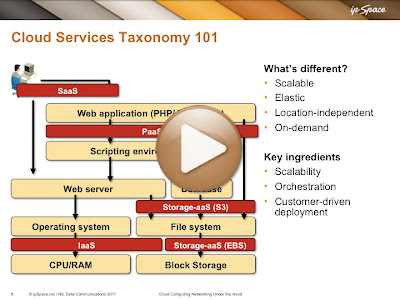
Cloud Services Taxonomy
One of the challenges of designing data center networks that support cloud service is agreeing on what exactly each one of those services should be doing. This video (part of the Cloud Computing Networking webinar) explains what various categories of cloud services actually do and where they could be used in a typical web application stack.