Category: BGP
BGP and Route Maps
This is a nice email I got from an engineer struggling with multi-homing BGP setup:
We faced a problem with our internet routers a few days back. The engineer who configured them earlier used the syntax: network x.x.x.x mask y.y.y.y route-map PREPEND to influence the incoming traffic over two service-providers.
... and of course it didn’t work.
Responsible Generation of BGP Default Route
Chris sent me the following question a while ago:
I've got a full Internet BGP table, and want to [responsibly]{.emphasis} send a default route to a downstream AS. It's the "responsibly" part that's got me frustrated: How can I judge whether the internet is working and make the origination of the default conditional on that?
He’d already figured out the neighbor default-originate route-map command, but wanted to check for more generic conditions than the presence of one or more prefixes in the IP routing table.
Changing configuration with EEM – yes or no?
Daniel left a very relevant comment to my convoluted BGP session shutdown solution:
What I am currently doing is using EEM to watch my tracked objects and then issuing a neighbor shutdown command. Is there a functional reason I would not want to do it that way, and use the method you prescribe?
As always, the answer is “it depends.” In this case, the question to ask yourself is: “do I track configuration changes and react to them?”
Shut Down BGP Session Based on Tracked Object
In responses to my The Road to Complex Designs is Paved With Great Recipes post Daniel suggested shutting down EBGP session if your BGP router cannot reach the DMZ firewall and Cristoph guessed that it might be done without changing the router configuration with the neighbor fall-over route-map BGP configuration command. He was sort-of right, but the solution is slightly more convoluted than he imagined.
… updated on Thursday, May 5, 2022 07:47 UTC
BGP Next Hop Processing
Following my IBGP or EBGP in an enterprise network post a few people have asked for a more graphical explanation of IBGP/EBGP differences. Apart from the obvious ones (AS path does not change inside an AS) and more arcane ones (local preference is only propagated on IBGP sessions, MED of an EBGP route is not propagated to other EBGP neighbors), the most important difference between IBGP and EBGP is BGP next hop processing.
DMVPN as a Backup for MPLS/VPN
SK left a long comment to my More OSPF-over-DMVPN Questions post describing a scenario I find quite often in enterprise networks:
- Primary connectivity is provided by an MPLS/VPN service provider;
- Backup connectivity should use DMVPN;
- OSPF is used as the routing protocol;
- MPLS/VPN provider advertises inter-site routes as external OSPF routes, making it hard to properly design the backup connectivity.
If you’re familiar with the way MPLS/VPN handles OSPF-in-VRF, you’re probably already asking the question, “How could the inter-site OSPF routes ever appear as E1/E2 routes?”
IBGP or EBGP in an enterprise network?
I got the following question from one of my readers:
I recently started working at a very large enterprise and learnt that the network uses BGP internally. Running IBGP internally is not that unexpected, but after some further inquiry it seems that we are running EBGP internally. I must admit I'm a little surprised about the use of EBGP internally and I wanted to know your thoughts on it.
Although they are part of the same protocol, IBGP and EBGP solve two completely different problems; both of them can be used very successfully in a large enterprise network.
BGP/IGP Network Design Principles
In the next few days, I'll write about some of the interesting topics we’ve been discussing during the last week’s fantastic on-site workshop with Ian Castleman and his team. To get us started, here’s a short video describing BGP/IGP network design principles. It’s taken straight from my Building IPv6 Service Provider Core webinar (recording), but the principles apply equally well to large enterprise networks.
The Road to Complex Designs Is Paved with Great Recipes
A while ago someone asked me to help him troubleshoot his Internet connectivity. He was experiencing totally weird symptoms that turned out to be a mix of MTU problems, asymmetric routing (probably combined with RPF checks on ISP side) and non-routable PE-CE subnets. While trying to figure out what might be wrong from the router configurations, I was surprised by the amount of complexity he’d managed to introduce into his DMZ design by following recipes and best practices we all dole out in blog posts, textbooks and training materials.
Changing VPNv4 route attributes within the MPLS/VPN network
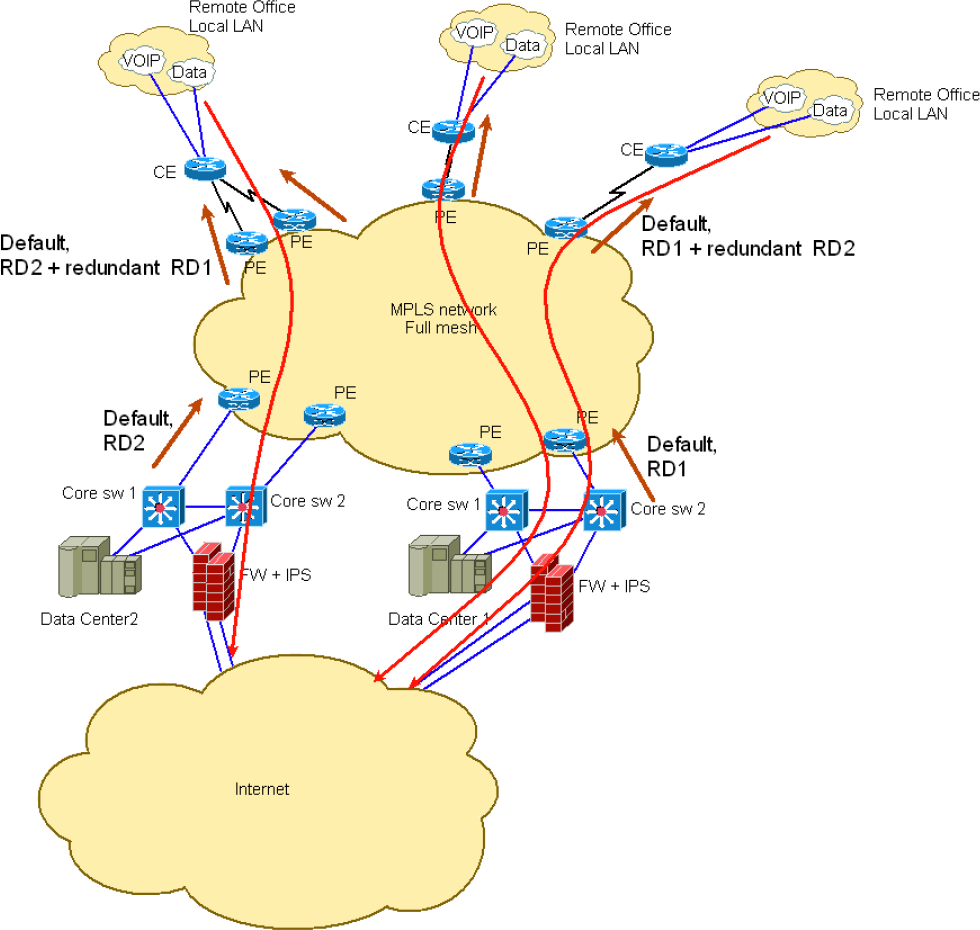
John (not a real name for obvious reasons) sent me an interesting challenge after attending my Enterprise MPLS/VPN Deployment webinar. He’s designed an MPLS/VPN network approximated by the following diagram: