
EIBGP Load Balancing
The next small step in my MPLS/VPN update project: EIBGP load balancing – why is it useful, how it works, why can’t you use it without full-blown MPLS/VPN, and what the alternatives are.
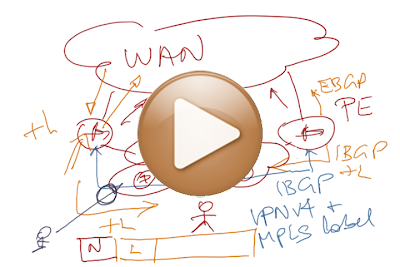
MPLS/VPN Carrier’s Carrier – Myth or Reality?
Andrew is struggling with MPLS/VPN providers and sent me the following question:
Is "carriers carrier" a real service? I'm having a bit of an issue at the moment with too many MPLS providers […] Carrier’s carrier would be an answer to many of them, but none of the carriers admit to being able to do this, so I was wondering if it's simply that I'm speaking to the wrong people, or whether they really don't...
Short answer: I have yet to see this particular unicorn roaming the meadows of reality.
Arista EOS Virtual ARP (VARP) Behind the Scenes
In the Optimal L3 Forwarding with VARP and Active/Active VRRP blog post I made a remark along the lines of “Things might get nasty [in Arista EOS Virtual ARP world] if you have configuration mismatches”, resulting in a lengthy and amazingly insightful email exchange with Lincoln Dale during which we ventured deeper and deeper down the Virtual ARP (VARP) rabbit hole. Here’s what I learned during out trip:
Implementing Control-Plane Protocols with OpenFlow
The true OpenFlow zealots would love you to believe that you can drop whatever you’ve been doing before and replace it with a clean-slate solution using dumbest (and cheapest) possible switches and OpenFlow controllers.
In real world, your shiny new network has to communicate with the outside world … or you could take the approach most controller vendors did, decide to pretend STP is irrelevant, and ask people to configure static LAGs because you’re also not supporting LACP.
Network Virtualization and Spaghetti Wall
I was reading What Network Virtualization Isn’t1 from Jon Onisick the other day and started experiencing all sorts of unpleasant flashbacks caused by my overly long exposure to networking industry missteps and dead ends touted as the best possible solutions or architectures in the days of their glory:
Will SPDY Solve Web Application Performance Issues?
In the TCP, HTTP and SPDY webinar I described the web application performance roadblocks caused by TCP and HTTP and HTTP improvements that remove most of them. Google went a step further and created SPDY, a totally redesigned HTTP. What is SPDY? Is it really the final solution? How much does it help? Hopefully you’ll find answers to some of these questions in the last part of the webinar.
The Difference between Access Lists and Prefix Lists
A while ago someone asked what the difference between access and prefix lists is on the Network Engineering Stack Exchange web site (a fantastic resource brought to life primarily by sheer persistence of Jeremy Stretch, who had to fight troves of naysayers with somewhat limited insight claiming everything one would want to discuss about networking falls under server administration web site).
The question triggered a lengthy wandering down the memory lane … and here's the history of how the two came into being (and why they are the way they are).
Published on , commented on July 10, 2022
Response: SDN’s Casualties
An individual focused more on sensationalism than content deemed it appropriate to publish an article declaring networking engineers an endangered species on an industry press web site that I considered somewhat reliable in the past.
The resulting flurry of expected blog posts included an interesting one from Steven Iveson in which he made a good point: it’s easy for the cream-of-the-crop not to be concerned, but what about others lower down the pile. As always, it makes sense to do a bit of reality check.
Dynamic Routing with Virtual Appliances
Meeting Brad Hedlund in person was definitely one of the highlights of my Interop 2013 week. We had an awesome conversation and quickly realized how closely aligned our views of VLANs, overlay networks and virtual appliances are.
Not surprisingly, Brad quickly improved my ideas with a radical proposal: running BGP between the virtual and the physical world.
Long Live Just Good Enough!
Today's Dilbert is dedicated to every networking and security vendor selling us just good enough solutions.

Huge "Thank you!" to Scott Adams for another well-explained documentary!