
Worth Reading: Modules, Monoliths, and Microservices
If you want to grow beyond being a CLI (or Python) jockey, it’s worth trying to understand things work… not only how frames get from one end of the world to another, but also how applications work, and why they’re structured they way they are.
Daniel Dib recently pointed out another must-read article in this category: Modules, monoliths, and microservices by Avery Pennarun – a wonderful addition to my distributed systems resources.
Video: Cisco SD-WAN Routing Design
After reviewing Cisco SD-WAN policies, it’s time to dig into the routing design. In this section, David Penaloza enumerated several possible topologies, types of transport, their advantages and drawbacks, considerations for tunnel count and regional presence, and what you should consider beforehand when designing the solution from the control plane’s perspective.
Topology- and Congestion-Driven Load Balancing
When preparing an answer to an interesting idea left as a comment to my unequal-cost load balancing blog post, I realized I never described the difference between topology-based and congestion-driven load balancing.
To keep things simple, let’s start with an easy leaf-and-spine fabric:
Azure Route Server: The Challenge
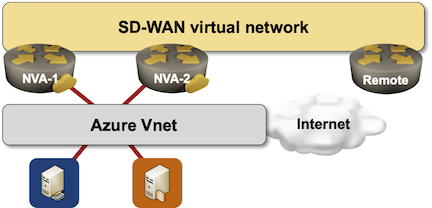
Imagine you decided to deploy an SD-WAN (or DMVPN) network and make an Azure region one of the sites in the new network because you already deployed some workloads in that region and would like to replace the VPN connectivity you’re using today with the new shiny expensive gadget.
Everyone told you to deploy two SD-WAN instances in the public cloud virtual network to be redundant, so this is what you deploy:
Interesting Tool: Schema Enforcer
It looks like JSON Schema is the new black. Last week I wrote about a new Ansible module using JSON Schema to validate data structures passed to it; a few weeks ago NetworkToCode released Schema Enforcer, a similar CLI tool (which means it’s easy to use it in any CI/CD pipeline).
Here are just a few things Schema Enforcer can do:
Implementing Layer-2 Networks in a Public Cloud
A few weeks ago I got an excited tweet from someone working at Oracle Cloud Infrastructure: they launched full-blown layer-2 virtual networks in their public cloud to support customers migrating existing enterprise spaghetti mess into the cloud.
Let’s skip the usual does everyone using the applications now have to pay for Oracle licenses and I wonder what the lock in might be when I migrate my workloads into an Oracle cloud jokes and focus on the technical aspects of what they claim they implemented. Here’s my immediate reaction (limited to the usual 280 characters, because that’s the absolute upper limit of consumable content these days):
MUST READ: Systems Design Explains the World
The one and only Avery Pennarun (of the world in which IPv6 was a good design fame) is back with another absolutely-must-read article explaining how various archetypes apply to real-world challenges, including:
- Hierarchies and decentralization (and why decentralization is a myth)
- Chicken-and-egg problem (and why some good things fail)
- Second-system effect (or why it’s better to refactor than to rewrite)
- Innovator’s dilemma (or why large corporations become obsolete)
If you think none of these applies to networking, you’re probably wrong… but of course please write a comment if you still feel that way after reading Avery’s article.
Worth Reading: Career Advice for Young Engineers
David Bombal invited me for another short chat – this time on what I recommend young networking engineers just starting their career. As I did a bit of a research I stumbled upon some great recommendations on Quora:
- How to identify a good electrical engineer
- What advice would you give young engineers early in their career?
- What are the most important things of working as an engineer that nobody mentioned in college?
I couldn’t save the pages to Internet Archive (looks like it’s not friendly with Quora), so I can only hope they won’t disappear ;)
Video: Path Discovery in Transparent Bridging and Routing
In the previous video in this series, I described how path discovery works in source routing and virtual circuit environments. I couldn’t squeeze the discussion of hop-by-hop forwarding into the same video (it would make the video way too long); you’ll find it in the next video in the same section.
New Ansible Data Validation Module(s)
A few months ago I described how you could use JSON Schema to validate your automation data models, host/group variable files, or even Ansible inventory file.
I had to use a weird toolchain to get it done – either ansible-inventory to build a complete data model from various inventory sources, or yq to convert YAML to JSON… and just for the giggles jsonschema CLI command requires the JSON input to reside in a file, so you have to use a temporary file to get the job done.