
Category: Workshop
FCoE between data centers? Forget it!
Was anyone trying to sell you the “wonderful” idea of running FCoE between Data Centers instead of FC-over-DWDM or FCIP? Sounds great ... until you figure out it won’t work. Ever ... or at least until switch vendors drastically increase interface buffers on the 10GE ports.
FCoE requires lossless Ethernet between its “routers” (Fiber Channel Forwarders – see Multihop FCoE 101 for more details), which can only be provided with Data Center Bridging (DCB) standards, specifically Priority Flow Control (PFC). However, if you want to have lossless Ethernet between two points, every layer-2 (or higher) device in the path has to support DCB, which probably rules out any existing layer-2+ solution (including Carrier Ethernet, pseudowires, VPLS or OTV). The only option is thus bridging over dark fiber or a DWDM wavelength.
FCoE, QCN and Frame Relay analogies
Just when I hoped we were finally getting somewhere with the FCoE/QCN discussion, Brocade managed to muddy the waters with its we-still-don’t-know-what-it-is announcement. Not surprisingly, networking consultants like my friend Greg Ferro of the Etherealmind fame responded to the shenanigan with statements like “FCoE ... is a technology so mindboggingly complicated that marketing people can argue over competing claims and all be correct.” Not true, the whole thing is exceedingly simple once you understand the architecture (and the marketing people always had competing claims).
Pretend for a minute that FC ≈ IP and LAN bridging ≈ Frame Relay, teleport into this parallel universe and allow me to tell you the whole story once again in more familiar terms.
Nexus 1000V: another IPv6 #FAIL
Just stumbled across this unbelievable fact in the Nexus 1000V release notes:
IPV6 ACL rules are not supported.
My first reaction: “You must be kidding, right? Are we still in 20th century?” ... and then it dawned on me: Nexus 1000V is using the NX-OS control plane and it’s still stuck in 4.0 release which did not support IPv6 ACLs (IPv6 support was added to NX-OS in release 4.1(2)).
Does FCoE need QCN (802.1Qau)?
One of the recurring religious FCoE-related debates of the last months is undoubtedly “do you need QCN to run FCoE” with Cisco adamantly claiming you don’t (hint: Nexus doesn’t support it) and HP claiming you do (hint: their switch software lacks FC stack) ... and then there’s this recent announcement from Brocade (more about it in a future post). As is usually the case, Cisco and HP are both right ... depending on how you design your multi-hop FCoE network.
Data Center Bridging (DCB) Congestion Notification (802.1Qau)
The last (and the least popular) Data Center Bridging (DCB) standard tries to solve the problem of congestion in large bridged domains (PFC enables lossless transport and ETS standardizes DWRR queuing). To illustrate the need for congestion control, consider a simple example shown in the following diagram:
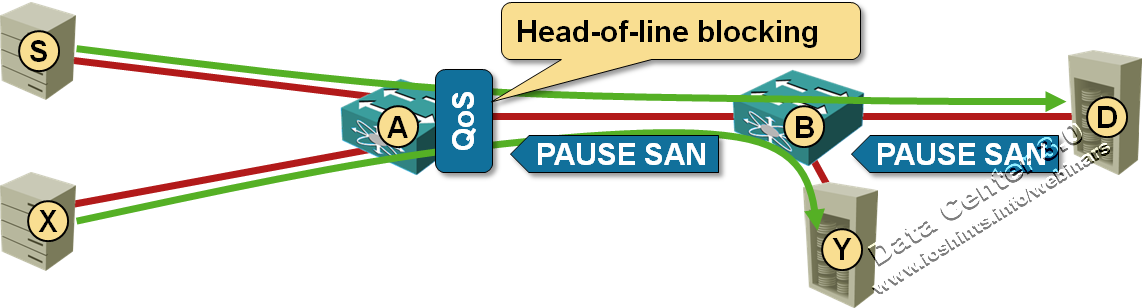
It came to my attention that a vendor might be using this blog post to justify the need for QCN in FCoE environments. Should that be the case, please make sure you also read about the difference between dense and sparse FCoE, the (lack of) need for QCN in FCoE and whether it makes sense to run FCoE over TRILL. Finally, consider how you’ll troubleshoot FCoE environments.
vCloud Director: hand the network over to server admins
A few months ago VMware decided to kick away one of the more stubborn obstacles in their way to Data Center domination: the networking team. Their vCloud architecture implements VLANs, NAT, firewalls and a bit of IP routing within the VMware hypervisor and add-on modules ... and just to make sure the networking team has no chance of interfering, they implemented MAC-in-MAC encapsulation, making their cloudy dreamworld totally invisible to the lowly net admins.
VPLS is a technology, not just a service provider offering
The Internet Exchange and Peering Points Packet Pushers Podcast is as good as the rest of them (listen to it first and then continue reading), but also strangely relevant to the data center engineers. When you look beyond the peering policies, route servers and BGP tidbits, an internet exchange is a high-performance large-scale layer-2 network that some data center switching vendors are dreaming about ... the only difference being that the internet exchanges have to perform extremely well using existing products and technologies, not the shortest-path-bridging futures promised by the vendors.
IPv6 Addressing: How Wrong Can You Get It?
Mike was wondering whether his ISP is giving him what he needs to start an IPv6 pilot within his enterprise network. He wrote:
So I got an IPv6 assignment with a /120 mask (basically our IPv4/24 network mapped to IPv6) and two smaller networks to use for links between our external router and the ISP.
Dear Mike’s ISP: where were you when the rest of the world was preparing to deploy IPv6? Did you read IPv6 Unicast Address Assignment Considerations (RFC 5375) or IPv6 Address Allocation and Assignment Policy from RIPE or your regional registry?
QoS over MPLS/VPN Networks
A while ago John McManus wrote a great DSCP QoS Over MPLS Thoughts article at Etherealmind blog explaining how 6-bit IP DSCP value gets mapped into 3-bit MPLS EXP bits (now renamed to Traffic Class field). The most important lesson from his post should be “there is no direct DSCP-to-EXP mapping and you have to coordinate your ideas with the SP”. Let’s dig deeper into the SP architecture to truly understand the complexities of this topic.
We’ll start with a reference diagram: user traffic is flowing from Site-A to Site-B and the Service Provider is offering MPLS/VPN service between PE-A and PE-B. Traffic from multiple customer sites (including Site-A) is concentrated at SW-A and passed in individual VLANs to PE-A.
Coping with long-distance vMotion requests
During the last Data Center webinar I got an interesting question when describing the inherent problems of long-distance vMotion: “OK, I understand all the implications, but how do I persuade my server admins?”
The best answer I’ve heard so far came from an old battle-hardened networking guru: “Well, let them try”.