
Category: Workshop
Load sharing in MPLS/VPN networks with route reflectors
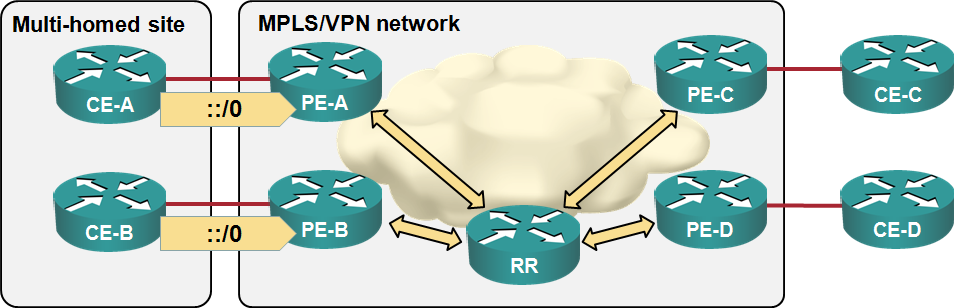
Some of the e-mails and comments I received after writing the “Changing VPNv4 route attributes” post illustrated common MPLS/VPN misconceptions, so it’s worth addressing them in a series of posts. Let’s start with the simplest scenario: load balancingsharing toward a multi-homed customer site. We’ll use a very simple MPLS/VPN network with three customer sites, four CE-routers, four PE-routers a route reflector:
End-to-End QoS marking in MPLS/VPN-over-DMVPN networks
I got a great question in one of my Enterprise MPLS/VPN Deployment webinars when I was describing how you could run MPLS/VPN across DMVPN cloud:
That sounds great, but how does end-to-end QoS work when you run IP-over-MPLS-over-GRE-over-IPSec-over-IP?
My initial off-the-cuff answer was:
Well, when the IP packet arriving through a VRF interface gets its MPLS label, the IP precedence bits from the IP packet are copied into the MPLS EXP (now TC) bits. As for what happens when the MPLS packet gets encapsulated in a GRE packet and when the GRE packet is encrypted… I have no clue. I need to test it.
Open FCoE – Software implementation of the camel jetpack
Intel announced its Open FCoE (software implementation of FCoE stack on top of Intel’s 10GB Ethernet adapters) using the cloudy bullshit bingo including simplifying the Data Center, Free New Technology, Cloud Vision and Green Computing (ok, they used Environmental impact) and lots of positive supporting quotes. The only thing missing was an enthusiastic Gartner quote (or maybe they were too expensive?).
VMware vSwitch does not support LACP
This is very old news to any seasoned system or network administrator dealing with VMware/vSphere: the vSwitch and vNetwork Distributed Switch (vDS) do not support Link Aggregation Control Protocol (LACP). Multiple uplinks from the same physical server cannot be bundled into a Link Aggregation Group (LAG, also known as port channel) unless you configure static port channel on the adjacent switch’s ports.
When you use the default (per-VM) load balancing mechanism offered by vSwitch, the drawbacks caused by lack of LACP support are usually negligible, so most engineers are not even aware of what’s (not) going on behind the scenes.
MPLS/VPN over mGRE strikes again
More than five years after the MPLS/VPN-in-mGRE encapsulation was standardized (add a few more years for the work-in-progress and IETF draft stages), it finally debuted in a mainstream-wannabe IOS release running on ISR routers (15.1(2)T), making it usable for the enterprise WAN designers, who are probably its best target audience.
I was writing about the two conflicting MPLS/VPN over mGRE implementations a while ago and got the impression the Service Providers aren’t too excited about this option. No wonder – most of them use full-blown MPLS backbones, so they have no need for GRE tunnels.
Internet-related links (2010-12-19)
GigaOm published two interesting articles by Joe Weinman: in the first one, he describes why pay-per-use residential broadband Internet is probably inevitable, in the second one he predicts changes in user behavior if the service providers decide to implement it. I would also suggest you take time and read his in-depth Market for Melons article.
Obviously, collecting money costs money and the pay-per-use model is no exception (not to mention that most people would pay less), so the service providers prefer usage caps. There are numerous ways to implement usage caps, but implementing usage cap as an acceptable use policy and calling exceeding the cap policy violation is not the way to do it. Some people are truly trying to alienate the users.
HP Virtual Connect: every vendor has its own dinosaurs
I was listening to the HP Virtual Connect (VC) PPP podcast recently and got the impression that HP VC is a weirdly convoluted product. I started wondering what exactly they were thinking when they were designing it ... and had the epiphany when Ken Henault took a step back and explained the history leading to the current complexity (listen to the Packet Pushers podcast to get the whole story)
DHCPv6 IA_PD relaying works with 12.2SRE2
Last week I ran numerous lab tests while preparing router configurations for the Building IPv6 Service Provider Core webinar. One of the fantastic test results: DHCPv6 relaying works correctly on a 7200 running 12.2(33)SRE2, even when the client requests IA_PD option.
Chinese BGP incident: was it a traffic hijack?
You’re probably familiar with the April fat fingers incident in which Chinanet (AS 23724) originated ~37.000 prefixes for about 15 minutes. The incident made it into the annual report of US Congress’ U.S.-China Economic and Security Review Commission (page 243 of this PDF) and the media was more than happy to pick it up (Andree Toonk has a whole list of links in his blog post). We might never know whether the misleading statements in the report were intentional or just a result of clueless technical advisors, but the facts are far away from what they claim:
Internet peering disputes: follow the money
You’ve probably heard about the recent peering dispute between Level-3 and Comcast ... and might have enjoyed the frenzy with which the blogging pundits have followed the false net neutrality scent left by Level-3 spin doctors.
Facts first: Level-3 is trying to dump huge amount of data into Comcast’s network for free.