
Category: SDN
Multi-Vendor OpenFlow – Myth or Reality?
NEC demonstrated multi-vendor OpenFlow network @ Interop Las Vegas, linking physical switches from Arista, Brocade, Centec, Dell, Extreme, Intel and NEC, and virtual switches in Linux (OVS) and Hyper-V (PF1000) environments in a leaf-and-spine fabric controlled by ProgrammableFlow controller (watch the video of Samrat Ganguly demonstrating the network).
Does that mean we’ve entered the era of multi-vendor OpenFlow networking? Not so fast.
Tail-f Network Control System – the First Impressions
One of the most pleasant surprises of the recent Interop show was the Tail-f's Network Control System (NCS). I “knew” Carl Moberg (of the NETCONF and YANG fame) for a long time and had the privilege to meet him in person just before the SDN Buyer's Guide panel that I co-hosted with Kurt Marko (who did an excellent job putting the buyer's guide together). Anyhow, what Carl presented during the panel totally blew me away.
Plexxi’s Dan Backman Presenting in the Data Center Fabrics Update Webinar
Plexxi has a really interesting data center fabric solution that combines CWDM optics with L2+L3 switching. They briefed me on their product just before their public launch; I like their approach, particularly the combination of robust traditional forwarding with controller-based network optimization that you can influence from the outside, but somehow I never quite found the time to blog about them … although I did manage to solve the hard part of the problem: write a Perl script that generates Graphviz graph description to generate schematics of their CWDM inter-switch links.
The First Glimpse of Open Daylight
Operating systems are boring (for most people); it’s the applications that make everyone excited. SDN is no different. Controllers are boring – someone has to reinvent all the wheels that the networking vendors have been inventing for the last 30 years before you can develop the sexy stuff ... but not many people outside of ivory towers would start developing the (supposedly) sexy SDN apps until being sure the underlying platform will not disappear into thin air.
The Many Paths to SDN
I did a major overhaul of my RIPE 65 SDN presentation prior to MENOG 12 meeting, including a more comprehensive overview of SDN-related technologies sorted by the networking device plane they operate on.
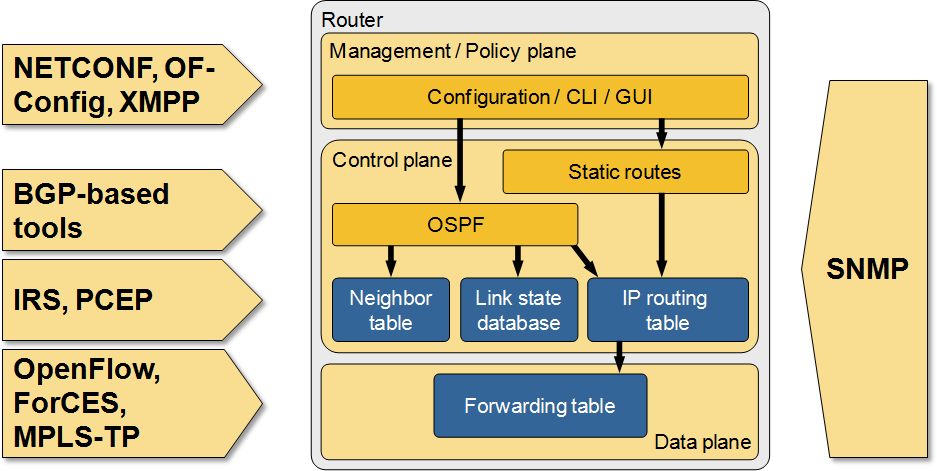
Many paths to SDN
What Did You Do to Get Rid of Manual VLAN Provisioning?
I love(d) listening to the Packet Pushers podcast and came to expect the following rant in every SDN-focused episode: “I’m sick and tired of using CLI to manually provision VLANs”. Sure, we’re all in the same boat, but did you ever do something to get rid of that problem?
Control-plane policing in OpenFlow networks
The Controller-Based Packet Forwarding in OpenFlow Networks post generated the obvious question: “does that mean we need some kind of Control-Plane Protection (CoPP) in OpenFlow controller?” Of course it does, but things aren’t as simple as that.
NEC ProgrammableFlow Scalability Features
Once you get rid of spanning tree and associated kludges (not too hard in OpenFlow-based networks), BUM flooding becomes your biggest enemy. NEC’s engineers implemented some interesting features in the ProgrammableFlow switches and controllers: rate-limiting of unknown unicast frames, flooding control, and ARP snooping (if only they’d go for ARP proxy).
Virtual Tenant Networks with NEC ProgrammableFlow
Virtual tenant networks are one of the best features of NEC ProgrammableFlow solution – you can build virtual layer-2 subnets (based on VLANs, edge ports or port/VLAN combos), connect them with a virtual router, and implement packet filters and traffic steering ... while treating the whole data center fabric as a single device.
Even better, the ingress edge switch performs all the operations you configure (ACLs, L2 lookup, L3 lookup, source/destination MAC rewrite), resulting in optimal end-to-end forwarding.
Daylight – Internet Explorer or Linux of the SDN World?
You’ve probably heard that the networking hardware vendors decided to pool resources to create an open-source OpenFlow controller. Just in case you’re wondering whether they lost their mind (no, they didn’t), here’s my cynical take.