
Category: IPv6
Troubleshooting Residential IPv6 Connectivity
Most ISPs rolling out large-scale residential IPv6 agree it’s a no-brainer, but the rest of the world still hesitates.
To help the dubious majority cross the (perceived) shaky bridge across the gaping chasm between IPv4 and IPv6, a team of great engineers with decades of IPv6 operational experience (including networking gurus from Time Warner, Comcast and Yahoo, and the never-tiring IPv6 evangelist Jan Žorž) wrote an IPv6 Troubleshooting for Helpdesks document.
IPv6-Only Data Center Deployment
Last June Tore Anderson talked about his IPv6-only data center deployment (the idea made very popular recently after Facebook’s presentation @ V6 World Congress) in one of my free webinars. In case you missed the videos explaining the technical details, watch them or view Tore’s slide deck.
Facebook Is Close to Having an IPv6-only Data Center
Whenever I mention the idea of IPv6-only data centers, I get the usual question: “Sounds great, but is anyone actually using it?” So far, my answer was: “Yeah, I know a great guy in Norway that runs this in production” As of last week, the answer is way more persuasive: “Facebook is almost there.”
Cisco IOS Supports RFC 6106 (RDNSS)
When Enno Rey mentioned RFC 6106 support (why does it matter?) on Cisco IOS during the opening presentation of Troopers 2014 IPv6 security summit I got interested but remained a bit skeptical. When Eric Vyncke (sitting in the audience) started nodding, I knew it must be there. Finding the feature in IOS documentation turned out to be mission impossible.
We’re All Brothers on Link-Local
I was listening to excellent opening presentation Enno Rey had at Troopers 2014 IPv6 security summit (he claimed he was ranting, but it sounded more like some of my polite blog posts) and when I’ve seen this slide I could literally hear a blog post clicking together in my head.
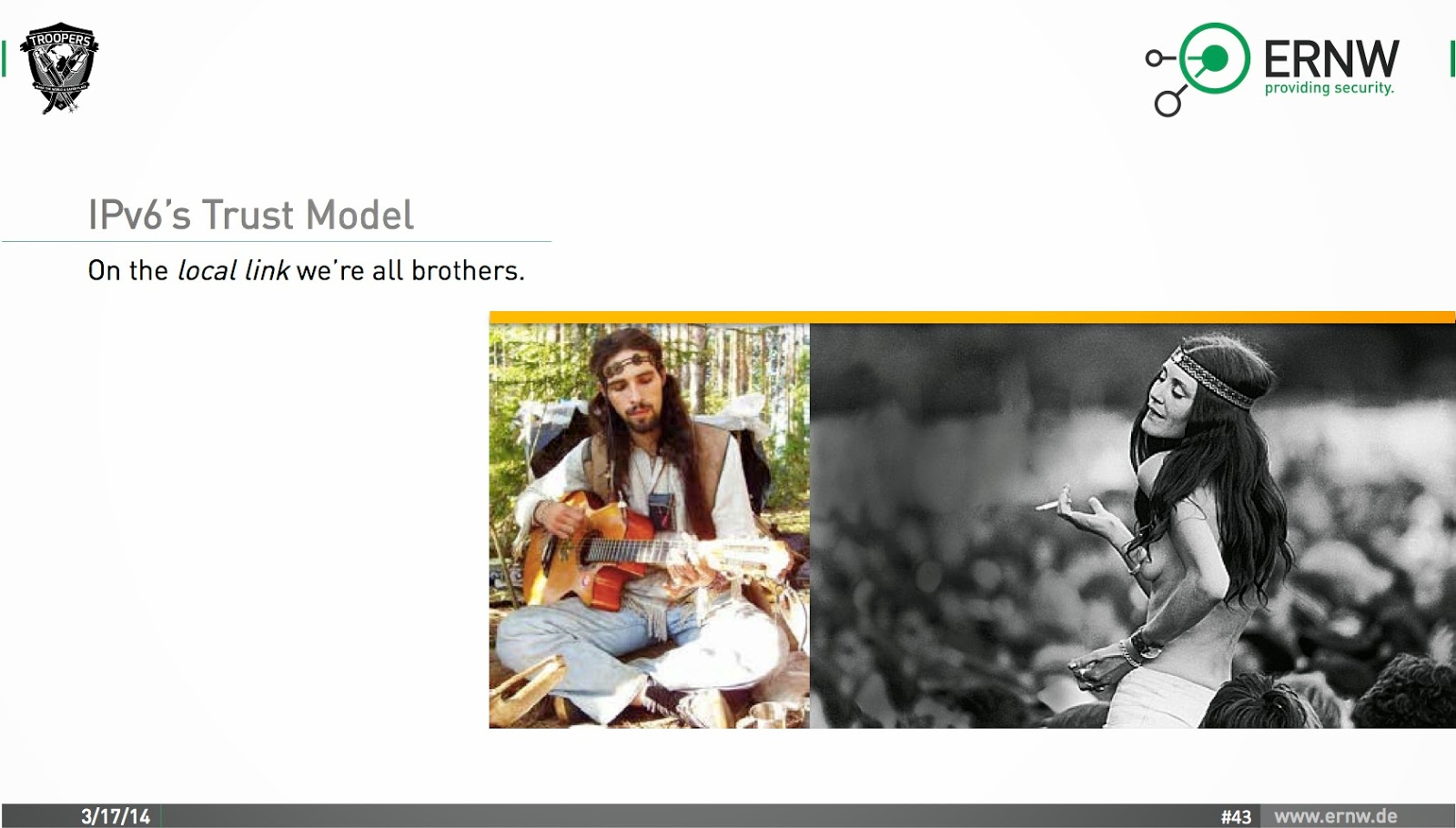
In short: IPv6 has many shortcomings, but this might not be one of them.
Can We Use IPv6 Router Advertisements for Fast Failover?
Ed Horley opened another juicy can of worms in a comment to my First-Hop Load Balancing in IPv6 post: can we use IPv6 RA for fast failover (and high availability)?
TL&DR summary: it depends.
Comparison of IPv6-over-IPv4 Tunneling Techniques
A while ago Sander Steffann and Iljitsch van Beijnum wrote a fantastic document that compared most (somewhat) widely used IPv6-over-IPv4 tunneling mechanisms. The document got published as RFC 7059 in November and is a definite must-read for anyone having to deal with this particular can of worms.
Unfortunately the document doesn’t cover the recent IPv4 sunset developments – numerous mechanisms that transport IPv4 leftovers over IPv6-only access networks (MAP-E, DS-Lite, lw4over6, 464XLAT …). One can only hope Sander and Iljitsch plan to produce a complementary document soon ;)
First-hop Load Balancing in IPv6
“I want default router address in DHCPv6 options” is a popular religious war on various IPv6 mailing lists. One of the underlying reasons is the need to implement poor man’s first hop load balancing (I won’t even consider the “I don’t want to think, so want IPv6 to behave like IPv4” mentality in this blog post), and as always, the arguments have more to do with suboptimal implementations than true technical needs.
IPv6 reachability between ULA and GUA endpoints
From the IPv6 Trivia department: can a host with an ULA address reach a service with a global IPv6 address? Can a host with only a link-local address reach a service with a global IPv6 address? The answer to both questions might be Yes (but you better know what scopes and zones are if you want to figure it out).
PA, PI or ULA IPv6 Address Space? It depends
Having “do we need ULA” blogologs with Ed Horley is great … and the best part of them is that we’re both right (aka: It Depends). OK, let’s try to quantify that last part.