
Category: Data Center
What Exactly Are Virtual Firewalls?
Kaage added a great comment to my Virtual Firewall Taxonomy post:
And many of physical firewalls can be virtualized. One physical firewall can have multiple virtual firewalls inside. They all have their own routing table, rule base and management interface.
He’s absolutely right, but there’s a huge difference between security contexts (to use the ASA terminology) and firewalls running in VMs.
VM-level IP Multicast over VXLAN
Dumlu Timuralp (@dumlutimuralp) sent me an excellent question:
I always get confused when thinking about IP multicast traffic over VXLAN tunnels. Since VXLAN already uses a Multicast Group for layer-2 flooding, I guess all VTEPs would have to receive the multicast traffic from a VM, as it appears as L2 multicast. Am I missing something?
Short answer: no, you’re absolutely right. IP multicast over VXLAN is clearly suboptimal.
Skip the Transitions, Build IPv6-Only Data Centers
During last week’s IPv6 Summit I presented an interesting idea first proposed by Tore Anderson: let’s skip all the transition steps and implement IPv6-only data centers.
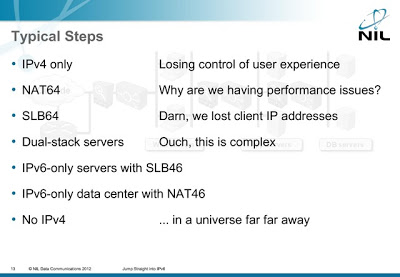
You can view the presentation or watch the video; for more details (including the description of routing tricks to get this idea working with vanilla NAT64), watch Tore’s RIPE64 presentation.
Is Layer-3 DCI Safe?
One of my readers sent me a great question:
I agree with you that L2 DCI is like driving without a seat belt. But is L3 DCI safer in case of DCI link failure? Let's say you have your own AS and PI addresses in use. Your AS spans multiple sites and there are external BGP peers on each site. What happens if the L3 DCI breaks? How will that impact your services?
Simple answer: while L3 DCI is orders of magnitude safer than L2 DCI, it will eventually fail, and you have to plan for that.
If Something Can Fail, It Will
During a recent consulting engagement I had an interesting conversation with an application developer that couldn’t understand why a fully redundant data center interconnect cannot guarantee 100% availability.
Published on , commented on July 10, 2022
SDN, Career Choices and Magic Graphs
The current explosion of SDN hype (further fueled by recent VMworld announcement of Software-Defined Data Centers) made some networking engineers understandably nervous. This is the question I got from one of them:
I have 8 plus years in Cisco, have recently passed my CCIE RS theory, and was looking forward to complete the lab test when this SDN thing hit me hard. Do you suggest completing the CCIE lab looking at this new future of Networking?
Short answer: the sky is not falling, CCIE still makes sense, and IT will still need networking people.
Cisco Nexus 3548: A Victory for Custom ASICs?
Autumn must be a perfect time for data center product launches: last week Brocade launched its core VDX switch and yesterday Arista and Cisco launched their new low-latency switches (yeah, the simultaneous launch must have been pure coincidence).
I had the opportunity to listen to Cisco’s and Arista’s product briefings, continuously experiencing a weird feeling of déjà vu. The two switches look like twin brothers … but there are some significant differences between the two:
Arista launches the first hardware VXLAN termination device
Arista is launching a new product line today shrouded in mists of SDN and cloud buzzwords: the 7150 series top-of-rack switches. As expected, the switches offer up to 64 10GE ports with wire speed L2 and L3 forwarding and 400 nanosecond(!) latency.
Also expected from Arista: unexpected creativity. Instead of providing a 40GE port on the switch that can be split into four 10GE ports with a breakout cable (like everyone else is doing), these switches group four physical 10GE SFP+ ports into a native 40GE (not 4x10GE LAG) interface.
But wait, there’s more...
Building Large L3 Fabrics with Brocade VDX Switches
A few days ago the title of this post would be one of those “find the odd word out” puzzles. How can you build large L3 fabrics when you have to work with ToR switches with no L3 support, and you can’t connect more than 24 of them in a fabric? All that has changed with the announcement of VDX 8770 – a monster chassis switch – and new version of Brocade’s Network OS with layer-3 (IP) forwarding.
Do we need LACP and UDLD?
The Nexus-focused Packet Pushers were discussing a great question during Cisco Nexus Deep Dive part 2 podcast: do we need LACP on top of UDLD?
Short answer: absolutely.