
Nicira Open vSwitch Inside vSphere/ESX
I got intrigued when reading Nicira’s white paper claiming their Open vSwitch can run within vSphere/ESX hypervisor. There are three APIs that you could use to get that job done: dvFilter API (intercepting VM NIC like vCDNI does), the undocumented virtual switch API used by Cisco’s Nexus 1000v, or the device driver interface (intercepting uplink traffic). Turns out Nicira decided to use a fourth approach using nothing but publicly available APIs.
Cloudy thoughts
We have a public holiday today, so I’ll spend the morning with my kids instead of writing yet another whatever-does-not-scale post. However, I did stumble across two fantastic cartoons that I simply have to share with you.
Nicira uncloaked
Nicira, the OpenFlow startup behind the Open vSwitch, has finally dropped the stealthy cloak. Congratulations!!! Their web site is still pretty sparse on details, but you can get an initial impression of what they’re doing from a number of white papers describing Network Virtualization Platform and DVNI architecture. Short summary: I was almost right, but being a routing-and-switching bloke missed a few interesting bits – OpenFlow (and Open vSwitch) can easily combine security and forwarding functionality.
Virtual Circuits in OpenFlow 1.0 World
Two days ago I described how you can use tunneling or labeling to reduce the forwarding state in the network core (which you have to do if you want to have reasonably fast convergence with currently-available OpenFlow-enabled switches). Now let’s see what you can do in the very limited world of OpenFlow 1.0.
Easy Virtual Network (EVN) – nothing new under the sun
For whatever reason, Easy Virtual Network (EVN), a configuration sugar-glaze on top of VRF-lite (oops, multi-VRF) that has been lurking in the shadows for the last 18 months erupted into the twittersphere after Cisco’s latest switching launch. I can’t possibly understand why the implementation of a decade-old technology on mature platform (Catalyst 4500 and Catalyst 6500) makes news at the time when 40GE and 100GE interfaces were launched, but the intricacies of marketing always somehow escaped me.
Forwarding State Abstraction with Tunneling and Labeling
Yesterday I described how the limited flow setup rates offered by most commercially-available switches force the developers of production-grade OpenFlow controllers to drop the microflow ideas and focus on state abstraction (people living in a dreamland usually go in a totally opposite direction). Before going into OpenFlow-specific details, let’s review the existing forwarding state abstraction technologies.
FIB Update Challenges in OpenFlow Networks
Last week I described the problems high-end service provider routers (or layer-3 switches if you prefer that terminology) face when they have to update large number of entries in the forwarding tables (FIBs). Will these problems go away when we introduce OpenFlow into our networks? Absolutely not, OpenFlow is just another mechanism to download forwarding entries (this time from an external controller) not a laws-of-physics-changing miracle.
Prefix-Independent Convergence (PIC): Fixing the FIB Bottleneck
Did you rush to try OSPF Loop-Free Alternate on a Cisco 7200 after reading my LFA blog post… and disappointedly discovered that it only works on Cisco 7600? The reason is simple: while LFA does add feasible-successor-like behavior to OSPF, its primary mission is to improve RIB-to-FIB convergence time.
Loop-Free Alternate: OSPF Meets EIGRP
Assume we have a simple triangular network:
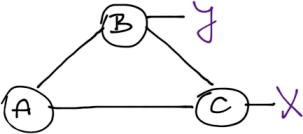
Now imagine the A-to-C link fails. How will OSPF react to the link failure as compared to EIGRP? Which one will converge faster? Try to answer the questions before pressing the Read more link ;)
VXLAN runs over UDP – does it matter?
Scott Lowe asked a very good question in his Technology Short Take #20:
VXLAN uses UDP for its encapsulation. What about dropped packets, lack of sequencing, etc., that is possible with UDP? What impact is that going to have on the “inner protocol” that’s wrapped inside the VXLAN UDP packets? Or is this not an issue in modern networks any longer?
Short answer: No problem.