
Skip the Transitions, Build IPv6-Only Data Centers
During last week’s IPv6 Summit I presented an interesting idea first proposed by Tore Anderson: let’s skip all the transition steps and implement IPv6-only data centers.
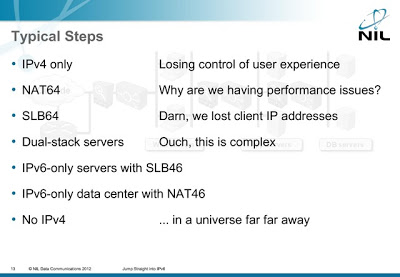
You can view the presentation or watch the video; for more details (including the description of routing tricks to get this idea working with vanilla NAT64), watch Tore’s RIPE64 presentation.
Is Layer-3 DCI Safe?
One of my readers sent me a great question:
I agree with you that L2 DCI is like driving without a seat belt. But is L3 DCI safer in case of DCI link failure? Let's say you have your own AS and PI addresses in use. Your AS spans multiple sites and there are external BGP peers on each site. What happens if the L3 DCI breaks? How will that impact your services?
Simple answer: while L3 DCI is orders of magnitude safer than L2 DCI, it will eventually fail, and you have to plan for that.
IPv6 First-Hop Security: Ideal OpenFlow Use Case
Supposedly it’s a good idea to be able to identify which one of your users had a particular IP address at the time when that source IP address created significant havoc. We have a definitive solution for the IPv4 world: DHCP server logs combined with DHCP snooping, IP source guard and dynamic ARP inspection. IPv6 world is a mess: read this e-mail message from v6ops mailing list and watch Eric Vyncke’s RIPE65 presentation for excruciating details.
If Something Can Fail, It Will
During a recent consulting engagement I had an interesting conversation with an application developer that couldn’t understand why a fully redundant data center interconnect cannot guarantee 100% availability.
Dear $Vendor, NETCONF != SDN
Some vendors feeling the urge to SDN-wash their products claim that the ability to “program” them through NETCONF (or XMPP or whatever other similar mechanism) makes them SDN-blessed.
There might be a yet-to-be-discovered vendor out there that creatively uses NETCONF to change the device behavior in ways that cannot be achieved by CLI or GUI configuration, but most of them use NETCONF as a reliable Expect script.
Disabling IP unreachables breaks pMTUd
A while ago someone sent me an interesting problem: the moment he enabled simple MPLS in his enterprise network with ip mpls interface configuration commands, numerous web applications stopped working. My first thought was “MTU problems” (the usual culprit), but path MTU discovery should have taken care of that.
Don’t use IPv6 RA on server LANs
Enabling IPv6 on a server LAN with the ipv6 address interface configuration without taking additional precautions might be a bad idea. All modern operating systems have IPv6 enabled by default, and the moment someone starts sending Router Advertisement (RA) messages, they’ll auto-configure their LAN interfaces.
Updated webinar roadmaps
The cloudy and cold autumn weather is the perfect backdrop for marketing-related work. I finally managed to update the webinar roadmaps: overview, data center, virtualization, IPv6 and VPN. And yes, you get immediate access to all that (over 46 hours of content) with the yearly subscription.
You MUST Take Control of IPv6 in Your Network
I’m positive most of you are way too busy dealing with operational issues to start thinking about IPv6 deployment (particularly if you’re working in the enterprise world; European service providers using the same “strategy” just got a rude wake-up call). Bad idea – if you ignore IPv6, it will eventually blow up in your face. Here’s how:
The best of RIPE65
Last week I had the privilege of attending RIPE65, meeting a bunch of extremely bright SP engineers, and listening to a few fantastic presentations (full meeting report @ RIPE65 web site).
I knew Geoff Huston would have a great presentation, but his QoS presentation was even better than I expected. I don’t necessarily agree with everything he said, but every vendor peddling QoS should be forced to listen to his explanation of the underlying problems and kludgy solutions first.