
… updated on Tuesday, January 5, 2021 07:47 UTC
Using IP Prefixes, AS Numbers and Domain Names in Examples
Keep in mind: Use private IP addresses, AS numbers and domain names in all technical documentation you're producing (unless, of course, you're describing an actual network). If you're forced to use public addresses or AS numbers (for example, to illustrate how the neighbor remote-private-as command works), you should clearly state that they are imaginary.
You can safely use:
Control Plane Protection inbound packet classification
The inability of Control Plane host interface to detect inbound OSPF packets has prompted Sebastian and myself to search for more documentation and conduct further tests. Sebastian already had a working configuration from which he could infer most of the configuration rules and he also found the well-written Understanding CPPr document on CCO. Together with the tests I ran in my router lab, we're pretty confident the CPPr inbound packet classification rules are (approximately) as follows:
How do you know you're an SP-geek
- You're creating a multi-AS BGP test lab on Sunday evening;
- The core AS is running 12.2SRC code;
- You insert a P-router in the core network ... because every large network has P-routers;
- You create BGP session templates instead of configuring two parameters of a few IBGP neighbors;
- You configure MPLS in the core network instead of using BGP on all routers ... because it saves you a few BGP sessions ... and that's the way things should be done anyway;
- When configuring OSPF, you define inter-AS links as passive interfaces ... not because you're running OSPF in the other AS but for security reasons :)
- ... add your comment here ...
Please Comment: Is Asymmetric Routing Harmful?
We've always been trying to minimize asymmetric routing, in both design and implementation phase, as it impacts a number of IP services/features, including:
- Network Address Translation;
- Content-based Access Control (CBAC);
- Reflexive access lists;
- Redundant firewalls (at least until recently);
- IP Multicast;
The “fallback global” VRF option does not exist in Cisco IOS
Cheng sent me an interesting question:
I'm reading your book MPLS and VPN Architecturesand I've found the ip vrf forwarding name fallback global command in the “Additional Lookup in the Global Routing Table” section. I can only find this command in Junos, but not in IOS.
… and he was right. When we were writing the book, we described several features that were still in development as it looked like they would be in the production code by the time the book was published. Many of them made it into the public IOS releases (for example, the Carrier's Carrier architecture), but some of them (like this command) simply vanished from the surface.
The Impact of tx-ring-limit
Setting the size of the hardware output queue in Cisco IOS with the (then undocumented) tx-ring-limit (formerly known as tx-limit) has been a big deal when I was developing the first version of the QoS course that eventually became the initial release of the Implementing Cisco Quality of Service training.
However, while it's intuitively clear that the longer hardware queue affects the QoS, years passed before I finally took the time to measure the actual impact.
Display operational IPv6 interfaces
The brief display of the state of IPv6 interfaces in the router (show ipv6 interface brief) is significantly different from the well-known show ip interface brief display as the IPv6 address might not fit in the same line as all the other data. To filter the printout and display only the operational interfaces, you have to replace the include filter with the section filter, which displays all the lines matching the regular expression as well as associated follow-up lines.
What Is CLNS?
According to the results of my recent Do you use CLNS poll, around 10% of my readers use CLNS in their network, while 36% of them wonder what that acronym stands for.
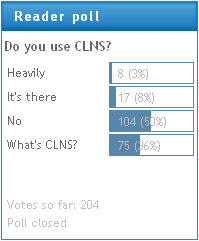
Let's start with the acronyms. CLNS (Connection-Less Network Service) in combination with CLNP (Connection-Less Network Protocol) is the ISO (International Standards Organization) equivalent to IP.
Almost-Dynamic Routing over ADSL Interfaces
Recently I had to implement Internet access using ADSL as the primary link and ISDN as the backup link. Obviously the most versatile solution would use the techniques described in my Small Site Multi-homing articles, but the peculiarities of Cisco IOS implementation of the ADSL technology resulted in a much simpler solution.
IOS implementation of PPPoE links uses dialer interfaces. However, the “dialing” on these interfaces is activated as soon as the underlying PPPoE session is active (before the first interesting packet is routed to the interface). When the simulated dial-out occurs, the router starts PPP negotiations including the IPCP handshake, which usually results in an IP address assigned to the dialer interface. Net result: if the dialer interface has an IP address, the PPPoE session is obviously active (and vice versa).
OSPFv3 Router ID: the Long Shadow of IPv4
One of the obscure facts about IPv6 OSPF (OSPFv3) is that it uses a 32-bit router ID like OSPFv2. It’s a reasonable choice; I have yet to see an OSPF network with over a billion routers. However, could you guess how this requirement is implemented in Cisco IOS? OSPFv3 searches for an IPv4 address (effectively the same algorithm used by OSPFv2) to get the router ID for the IPv6 routing process. Neat, isn’t it?
You might wonder what happens if you want to configure an IPv6-only router. OSPF won’t start unless you configure the router ID manually. And, no, you cannot enter a number (which would be the expected format, as the router ID is just a number in the IPv6 world); you have to enter an IPv4 address. Long live IPv4 :))