
netlab: Execute a Command on Multiple Devices
When I was updating the Network Migration with BGP Local-AS Feature blog post, I wanted to execute the same command (show ip bgp) on all routers in my network.
Not a problem: since Dan Partelly added the netlab exec command, it’s as simple as netlab exec * show ip bgp. Well, not exactly; there are still a few quirks.
Response: Peer-to-Peer Communication in IPv6 World
Daryll Swer posted a very informative response to my NAT Traversal Mess blog post, focusing on:
Punching holes through that firewall is equivalent to establishing NAT translations.
It would be a shame to let that response wither as small print at the bottom of a blog post; here it is:
Response: NAT Traversal Mess
Let’s look at another part of the lengthy comment Bob left after listening to the Rise of NAT podcast. This one is focused on the NAT traversal mess:
You mentioned that only video-conferencing and BitTorrent use client-to-client connectivity (and they are indeed the main use cases), but hell, do they need to engineer complex systems to circumvent these NATs and firewalls: STUN, TURN, ICE, DHT…
Cleaning up the acronym list first: DHT is unlike the others and has nothing to do with NAT.
iBGP Local-AS Next Hop Requirements
Did you know you could use the neighbor local-as BGP functionality to fake an iBGP session between different autonomous systems? I knew Cisco IOS supported that monstrosity for ages (supposedly “to merge two ISPs that have different AS numbers”) and added the appropriate tweaks1 into netlab when I added the BGP local-as support in release 1.3.1. Someone couldn’t resist pushing us down that slippery slope, and we ended with IBGP local-as implemented on 18 platforms (almost a dozen network operating systems).
I even wrote a related integration test, and all our implementations passed it until I asked myself a simple question: “But does it work?” and the number of correct implementations that passed the test without warnings dropped to zero.
Transitioning into Networking, 2025 Edition
Elmer sent me the following question:
I’ve been working in systems engineering (Linux, virtualization, infrastructure ops) and am considering shifting toward network engineering or architecture. I got my CCNA years ago and started CCNP but didn’t continue.
I’d really appreciate any thoughts you might have on how someone with my background could best make that transition today, especially with how things are evolving around automation and the cloud.
I keep answering a variant of this question every other year or so (2019, 2021, 2023, 2024). I guess it’s time for another answer, so here we go.
ARP Challenges in EVPN/VXLAN Symmetric IRB
Whenever I claimed that EVPN is The SIP of Networking, vendor engineers quickly told me that “EVPN interoperability is a solved problem” and that they run regular multi-vendor interoperability labs to iron out the quirks. As it turns out, things aren’t as rosy in real life; it’s still helpful to have an EVPN equivalent of the DTMF tone generators handy.
I encountered a particularly nasty quirk when running the netlab EVPN integration test using symmetric IRB with an anycast gateway between Nokia SR Linux (or Juniper vSwitch) and FRR container.
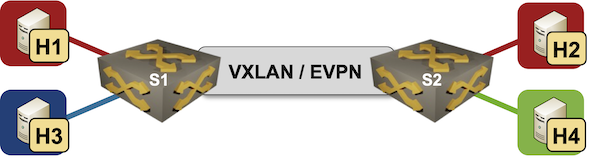
Lab topology
Comparing IP and CLNP: Local (Node) Multihoming
Another area where CLNP is a clear winner when compared to the TCP/IP stack is multi-homed nodes (nodes with multiple interfaces, not site multi-homing, where whole networks are connected to two upstream providers).
Multi-homed TCP/IP nodes must have multiple IP addresses because IP uses address interfaces. There is no well-defined procedure in TCP/IP for how a multi-homed node should behave. In the early days of TCP/IP, they tried to address that in RFC 1122 (Host Requirements RFC), but even then, there were two ideas about dealing with multiple interfaces: the strong and weak end system models (more details).
Worth Reading: Why Quantum Crypto is Bollocks
Today is a perfect day to point out the fantastic Why Quantum Cryptanalysis is Bollocks presentation (HT: A blog post by George Michaelson)
It’s a must-read, even if you’re absolutely uninterested in the topic. Just replace “Quantum mumbo-jumbo” with AI or SDN ;) Have fun!
Passive BGP Sessions
The Dynamic BGP Peers lab exercise gave you the opportunity to build a large-scale environment in which routers having an approved source IP addresses (usually matching an ACL/prefix list) can connect to a BGP route reflector or route server.
In a more controlled environment, you’d want to define BGP neighbors on the BGP RR/RS but not waste CPU cycles trying to establish BGP sessions with unreachable neighbors. Welcome to the world of passive BGP sessions.
Response: Any-to-Any Connectivity in the Internet
Bob left a lengthy comment arguing with the (somewhat black-and-white) claims I made in the Rise of NAT podcast. Let’s start with the any-to-any connectivity:
From my young millennial point of view, the logic is reversed: it is because of NATs and firewalls that the internet became so asymmetrical (client/server) just like the Minitel was designed (yes, I am French), whereas the Internet (and later the web, although a client/server protocol, was meant for everyone to be a client and a server) was designed to be more balanced.
Let’s start with the early Internet. It had no peer-to-peer applications. It connected a few large computers (mainframes) that could act as servers but also allowed terminal-based user access and thus ran per-user clients.