
Jerikan+Ansible: a Configuration Management System
Vincent Bernat and his team open-sourced Jerikan, a production-grade network configuration management system.
It might not be immediately applicable to your network, but I’m positive you could find tons of good ideas in it.
Interesting: What's Wrong with Bitcoin
I read tons of articles debunking the blockchain hype, and the stupidity of waisting CPU cycles and electricity on calculating meaningless hashes; here’s a totally different take on the subject by Avery Pennarun (an update written ten years later).
TL&DR: Bitcoin is a return to gold standard, and people who know more about economy than GPUs and hash functions have figured out that’s a bad idea long time ago.
Non-Stop Routing (NSR) 101
After Non-Stop Forwarding, Stateful Switchover and Graceful Restart, it’s time for the pinnacle of high-availability switching: Non-Stop Routing (NSR)1.
The PowerPoint-level description of this idea sounds fantastic:
- A device runs two active copies of its control plane.
- There is no cold/warm start of the backup control plane. The failover is almost instantaneous.
- The state of all control plane protocols is continuously synchronized between the two control plane instances. If one of them fails, the other one continues running.
- A failure of a control plane instance is thus invisible from the outside.
If this sounds an awful lot like VMware Fault Tolerance, you’re not too far off the mark.
Building a Separate Infrastructure for Guest Access
One of my readers sent me an age-old question:
I have my current guest network built on top of my production network. The separation between guest- and corporate network is done using a VLAN – once you connect to the wireless guest network, you’re in guest VLAN that forwards your packets to a guest router and off toward the Internet.
Our security team claims that this design is not secure enough. They claim a user would be able to attach somehow to the switch and jump between VLANs, suggesting that it would be better to run guest access over a separate physical network.
Decades ago, VLAN implementations were buggy, and it was possible (using a carefully crafted stack of VLAN tags) to insert packets from one VLAN to another (see also: VLAN hopping).
… updated on Tuesday, February 15, 2022 15:42 UTC
Creating BGP Multipath Lab with netlab
I was editing the BGP Multipathing video in the Advanced Routing Protocols section of How Networks Really Work webinar, got to the diagram I used to explain the intricacies of IBGP multipathing and said to myself “that should be easy (and fun) to set up with netlab”.
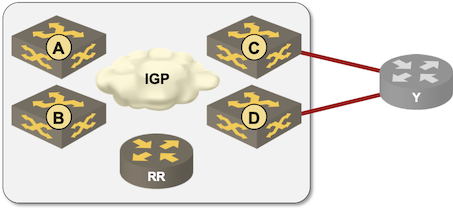
Fifteen minutes later1 I had the lab up and running and could verify that BGP works exactly the way I explained it in the webinar.
Feedback: Business Aspects of Networking
Every other blue moon someone asks me to do a not-so-technical presentation at an event, and being a firm believer in frugality I turn most of them into live webinar sessions collected under the Business Aspects of Networking umbrella.
At least some networking engineers find that perspective useful. Here’s what Adrian Giacometti had to say about that webinar:
Managing Hierarchical Device Configurations
Parsing and modifying IOS-like hierarchical device configurations is an interesting challenge, more so if you have no idea what the configuration commands mean or whether their order is relevant (I’m looking at you, Ansible ;).
Network to Code team decided to solve that problem for good, open-sourced Hierarchical Configuration Python library, and published a getting started article on their blog.
Soap Opera: SRv6 Is Insecure
I heard about SRv6 when it was still on the drawing board, and my initial reaction was “Another attempt to implement source routing. We know how that ends.” The then-counter-argument by one of the proponents went along the lines of “but we’ll use signed headers to prevent abuse” and I thought “yeah, that will work really well in silicon implementations”.
Years later, Andrew Alston decided to document the state of the emperor’s wardrobe (TL&DR: of course SRv6 is insecure and can be easily abused) and the counter-argument this time was “but that applies to any tunnel technology”. Thank you, we knew that all along, and that’s not what was promised.
You might want to browse the rest of that email thread; it’s fun reading unless you built your next-generation network design on SRv6 running across third-party networks… which was another PowerPoint case study used by SRv6 proponents.
Video: How Can You Master Public Cloud Networking?
If you’re a regular reader of this blog, you’ve probably realized there’s still need for networking in public clouds, and mastering it requires slightly different set of skills. What could you as a networking engineer to get fluent in this different world? I collected a few hints in the last video in Introduction to Cloud Computing webinar.
… updated on Saturday, November 6, 2021 13:31 UTC
Why Does Internet Keep Breaking?
James Miles sent me a long list of really good questions along the lines of “why do we see so many Internet-related outages lately and is it due to BGP and DNS creaking of old age”. He started with:
Over the last few years there are more “high profile” incidents relating to Internet connectivity. I raise the question, why?
The most obvious reason: Internet became mission-critical infrastructure and well-publicized incidents attract eyeballs.
Ignoring the click baits, the underlying root cause is in many cases the race to the bottom. Large service providers brought that onto themselves when they thought they could undersell the early ISPs and compensate their losses with voice calls (only to discover that voice-over-Internet works too well).