
… updated on Wednesday, September 28, 2022 17:22 UTC
Combining MLAG Clusters with VXLAN Fabric
In the previous MLAG Deep Dive blog posts, we discussed the innards of a standalone MLAG cluster. Now let’s see what happens when we connect such a cluster to a VXLAN fabric – we’ll use our standard MLAG topology and add a VXLAN transport underlay to it with another switch connected to the other end of the underlay network.
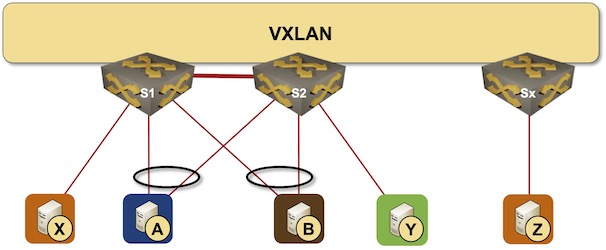
MLAG cluster connected to a VXLAN fabric
Repost: On the Viability of EVPN
Jordi left an interesting comment to my EVPN/VXLAN or Bridged Data Center Fabrics blog post discussing the viability of using VXLAN and EVPN in times when the equipment lead times can exceed 12 months. Here it is:
Interesting article Ivan. Another major problem I see for EPVN, is the incompatibility between vendors, even though it is an open standard. With today’s crazy switch delivery times, we want a multi-vendor solution like BGP or LACP, but EVPN (due to vendors) isn’t ready for a multi-vendor production network fabric.
netlab VXLAN Bridging Example
netlab release 1.3 introduced support for VXLAN transport with static ingress replication. Time to check how easy it is to replace a VLAN trunk with VXLAN transport. We’ll use the lab topology from the VLAN trunking example, replace the VLAN trunk between S1 and S2 with an IP underlay network, and transport Ethernet frames across that network with VXLAN.
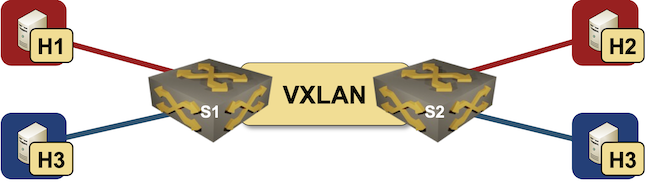
Lab topology
Worth Reading: The Hierarchy Is Bullshit
Charity Majors published another masterpiece: The Hierarchy Is Bullshit (And Bad For Business).
I doubt that anyone who would need this particular bit of advice would read or follow it, but (as they say) hope springs eternal.
Video: Cloud-Native Environments
One of the overused buzzwords of the cloudy days is the Cloud-Native Environment. What should that mean and why could that be better than what we’ve been doing decades ago? Matthias Luft and Florian Barth tried to answer that question in the Introduction to Cloud Computing webinar.
SR-MPLS or SRv6 for Greenfield Networks
Here’s an interesting question randomly appearing in my Twitter feed:
If you had a greenfield network, would you choose SR-MPLS, or SRv6? And why?
TL&DR: SR-MPLS, assuming you’re building a network providing end-to-end connectivity between hardware edge devices.
Now for the why part of the question:
Linux Networking Data Plane Configuration
I spent a rainy day implementing VLANs, VRFs, and VXLAN on Cumulus Linux VX and came to “appreciate” the beauties of Linux networking configuration.
TL&DR: It sucks
There are two major ways of configuring data plane constructs (interfaces, port channels, VLANs, VRFs) on Linux:
EVPN/VXLAN or Bridged Data Center Fabric?
An attendee in the Building Next-Generation Data Center online course sent me an interesting dilemma:
Some customers don’t like EVPN because of complexity (it is required knowledge BGP, symmetric/asymmetric IRB, ARP suppression, VRF, RT/RD, etc). They agree, that EVPN gives more stability and broadcast traffic optimization, but still, it will not save DC from broadcast storms, because protections methods are the same for both solutions (minimize L2 segments, storm-control).
We’ll deal with the unnecessary EVPN-induced complexity some other time, today let’s start with a few intro-level details.
netlab Release 1.3.1: BGP local-as, FRR and Cumulus Data Plane Enhancements
netlab release 1.3.1 contains major additions to FRR and Cumulus Linux, and new BGP features:
- VXLAN, VLANs, VRFs, and EVPN implemented on FRR and Cumulus Linux
- BGP local-as implemented in the BGP configuration module and supported on Arista EOS, Cisco IOS, Dell OS10, FRR, and Nokia SR Linux.
- Configurable BGP transport sessions
- Configurable default BGP address families supported on Arista EOS, Cisco IOS, Cumulus Linux, FRR, and Nokia SR Linux.
Here are some of the other goodies included in this release:
The Basics of Network Address Translation (NAT)
The last video in the 2-hour-long Network Addressing part of How Networks Really Work discusses Network Address Translation.
After watching it, you might want to spend some extra quality time (with a bit of soap opera vibe) enjoying the recent Dual ISP deployment operational issues and uncertainties thread on the v6ops mailing list with a “surprising” result: NPTv6 or NAT66 is the least horrible way to do it.