
Category: Workshop
Do we need DHCPv6 Relay Redundancy?
Instead of drinking beer and lab-testing vodka during the PLNOG party I enjoyed DHCPv6 discussions with Tomasz Mrugalski, the “master-of-last-resort” for the ISC’s DHCPv6 server. I mentioned my favorite DHCPv6 relay problem (relay redundancy) and while we immediately agreed I’m right (from the academic perspective), he brought up an interesting question – is this really an operational problem?
NEC+IBM: Enterprise OpenFlow you can actually touch
I didn’t expect we’d see multi-vendor OpenFlow deployment any time soon. NEC and IBM decided to change that and Tervela, a company specialized in building messaging-based data fabrics, decided to verify their interoperability claims. Janice Roberts who works with NEC Corporation of America helped me get in touch with them and I was pleasantly surprised by their optimistic view of OpenFlow deployment in typical enterprise networks.
IBM launched a Nexus 1000V competitor
Three days ago IBM launched Distributed Virtual Switch 5000V, its own distributed vSwitch for VMware ESX platform. On one hand, it proves Cisco has been going the right way with Nexus 1000v (just in case you wondered), on the other hand, things just got way more interesting – IBM is obviously returning to networking.
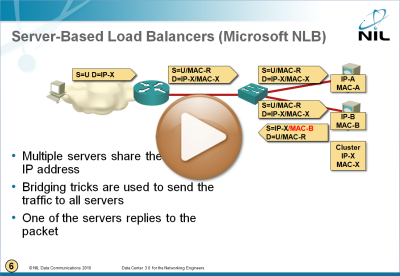
Microsoft Network Load Balancing Behind the Scenes
I figured out I wrote a lot about Microsoft Network Load Balancing (NLB) without ever explaining how that marvel of engineering works. To fix that omission, here’s a short video taken from the Data Center 3.0 webinar.
Nicira, BigSwitch, NEC, OpenFlow and SDN
Numerous articles published in the last few days describing how Nicira clashes heads-on with Cisco and Juniper just proved that you should never let facts interfere with a good story (let alone eye-catching headline). Just in case you got swayed away by those catchy stories, here’s the real McCoy (as I see it):
Easy Virtual Network (EVN) – nothing new under the sun
For whatever reason, Easy Virtual Network (EVN), a configuration sugar-glaze on top of VRF-lite (oops, multi-VRF) that has been lurking in the shadows for the last 18 months erupted into the twittersphere after Cisco’s latest switching launch. I can’t possibly understand why the implementation of a decade-old technology on mature platform (Catalyst 4500 and Catalyst 6500) makes news at the time when 40GE and 100GE interfaces were launched, but the intricacies of marketing always somehow escaped me.
Forwarding State Abstraction with Tunneling and Labeling
Yesterday I described how the limited flow setup rates offered by most commercially-available switches force the developers of production-grade OpenFlow controllers to drop the microflow ideas and focus on state abstraction (people living in a dreamland usually go in a totally opposite direction). Before going into OpenFlow-specific details, let’s review the existing forwarding state abstraction technologies.
FIB Update Challenges in OpenFlow Networks
Last week I described the problems high-end service provider routers (or layer-3 switches if you prefer that terminology) face when they have to update large number of entries in the forwarding tables (FIBs). Will these problems go away when we introduce OpenFlow into our networks? Absolutely not, OpenFlow is just another mechanism to download forwarding entries (this time from an external controller) not a laws-of-physics-changing miracle.
VXLAN runs over UDP – does it matter?
Scott Lowe asked a very good question in his Technology Short Take #20:
VXLAN uses UDP for its encapsulation. What about dropped packets, lack of sequencing, etc., that is possible with UDP? What impact is that going to have on the “inner protocol” that’s wrapped inside the VXLAN UDP packets? Or is this not an issue in modern networks any longer?
Short answer: No problem.
Are Provider-Independent IPv6 Prefixes Really Global?
Aleksej sent me an intriguing question: “Can the /48 PI block that a global company is assigned be attached to any region, or it is region-specific?”, or, more specifically:
Imagine a company with major DC with public services in EMEA. Centralized internet break-out in Europe fails and this DC must be reachable from Asia or America - but with the same IPv6 address? That would require Asia or America's ISPs to accept injection of this same subnet in their region. Do they do that?
In theory, the answer is yes. In practice, some global organizations are hedging their bets.