
How do I stop all logging done by the router
Although you probably don't ever want to stop all router's logging activities (at the very minimum you should collect the messages in a memory buffer with the logging buffered command), the global configuration command to do it is no logging on.
Disable console logging
Large amount of logging output (most often produced in a debugging process) sent to a router's console can significantly increase the router's CPU load and even stop the box from forwarding packets (high-end routers with distributed forwarding architecture are obviously an exception, but even they can lose routing adjacencies). The reason is very simple - console interrupt is one of the highest-priority interrupts on the router (otherwise you wouldn't be able to get a response to the BREAK key on a hung box).
Remove timestamps from syslog messages
The ability to replace router uptime with date and time in the logging messages with the service timestamps log datetime command was present in IOS for a long time, but I was always annoyed at timestamps when collecting syslog messages for demonstration purposes. The command to turn them off has also been available "forever", but was too obvious for me to try out ... the no service timestamps log command.
Configuration rollback fails completely with IP SLA
The Configuration Rollback feature (first available in IOS release 12.3(7)T) fails completely when handling configurations containing active IP SLA probes.
Per-destination or per-packet CEF load sharing?
Cisco Express Forwarding (CEF) can perform per-packet or per-destination (actually source/destination IP address pair) load-sharing with no performance degradation (without CEF, per-packet load-sharing requires process switching).
Even though there is no performance impact on the router, per-packet load sharing will almost always result in out-of-order packets. The packet reordering might degrade TCP throughput in high-speed environments (in low-speed/few-flows scenarios, per-packet load-sharing actually improves the per-flow throughput) or severely impact applications that cannot survive out-of-order packet delivery, such as Fast Sequenced Transport for SNA over IP or voice/video streams.
Configuration Change Logging ignores the configuration downloads
The Configuration Change Notification and Logging feature is supposed to log changes to the router's configuration. While it does a great job of logging commands entered in the router configuration mode, it completely ignores configuration changes due to configuration download (for example, with configure network or copy tftp running-config command).
Which switching path does an IOS feature use
I've got an excellent question recently: Which switching path is used in Zone-based firewalls when a packet is dropped? As usual, IOS documentation was not very helpful (which is understandable as the answer might depend on hardware platform, interface encapsulation, other features configured on the router etc.). However, there is a great tool to use - the show interface stats command.
Fine-Tuning CEF Load Balancing
In environments with a low number of IP hosts you have to fine-tune the CEF load-sharing algorithm to ensure that the traffic is spread between all parallel paths. A typical scenario is a primary-backup data center setup with pairs of replicating servers, as shown in the figure below.
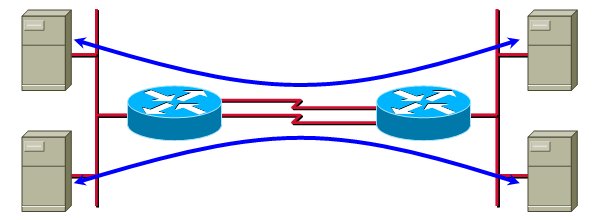
In these cases, you have to try different values of seed parameter of the CEF universal algorithm.
Local username authentication
As I get a lot of hits from Google refering to local login, here's the whole story: Cisco IOS supports local username/password based authentication (almost) forever (it's been there even before the AAA architecture). To change from simple password-based authentication to username+password based on, use login local configuration command on console and/or VTY lines. The local usernames and passwords are defined with the username configuration command.
IOS HTTP client sets Host: field to IP address
Update 2012-08-27: Stefan de Kooter reported the bug had been fixed in IOS release 15.1(4)M.
If you run multiple web sites on a single physical server, it's highly likely that you rely on the ability of HTTP/1.1 clients to specify the Host: field in the HTTP request to indicate which web site they're trying to access.
Cisco IOS always inserts the web server's IP address (not the hostname) in the Host: field of the HTTP request, regardless of whether you enter IP address or hostname in the URL part of an IOS command that supports HTTP (for example, copy or more command) ... and regardless of whether the hostname is locally configured with the ip host command or resolved by an external DNS server specified in the ip name-server command.